

The start of a new year gives individuals and businesses the opportunity for a good health check-up on their financial situation and to strategize for the year ahead. Cash flow needs, gifting strategies, philanthropic goals, estate plans and asset allocation may need to be updated depending on your financial needs and long-term planning goals. Additionally, with the new One Big Beautiful Bill Act (OBBBA) tax bill, this year offers a litany of legislative changes that may positively impact taxpayers. In this blog post, we explore the various planning opportunities 2026 has to offer.
Cash Flow Projection and Analysis
The first quarter of the new year is an ideal time to review ongoing cash flow needs and any new or one-time expenses. A cash flow projection, or mapping out income sources versus cash needs, can help evaluate any cash surplus or cash shortfall. It is important to identify any changes in recurring costs, like healthcare premiums, to ensure that the cash flow and withdrawals currently in place are sufficient for your lifestyle. Beyond recurring costs, it is also helpful to identify large, one-off expenses as early as possible. Whether it’s a vacation, remodel, life event, or a healthcare expense; eliminating as much of the surprise as possible may help mitigate the financial burden and capitalize on planning opportunities.
Your age and tax bracket may help dictate where funds are withdrawn from. Financial planning can help identify pre- and post-retirement strategies for saving and spending. The “gap years” of retirement, or years between retirement and the start of various retirement income sources, such as Social Security or Required Minimum Distributions (RMDs), may result in inconsistent income. RMDs, Social Security, pensions, and annuity payments may offer different starting points, pushing income up and down throughout the early stages of retirement. Roth conversions may make sense for individuals in a low tax year before fixed retirement income starts.
- Taxable accounts are often most flexible, given no age restrictions for withdrawal. Capital gains are taxed at a more favorable federal rate and can help bridge income gaps or cover larger one-time expenses.
- Tax-deferred accounts typically require minimum distributions starting at age 73. Individuals over the age of 59 ½ can avoid early withdrawal penalties on IRAs, 401(k)s, and 403(b) plans, however withdrawals are taxed at ordinary income rates.
- Certain IRAs allow for donations direct to charity via Qualified Charitable Distributions (QCDs) after age 70 ½. For philanthropic individuals, preserving funds in eligible IRAs until later in the tax year can give donors the opportunity to give via QCDs.
- Tax-free accounts such as Roth IRAs and Roth 401(k)s can be utilized in higher income tax years or as potential insurance for unforeseen expenses.
Asset Allocation Review
Asset allocation is the main driver of long-term investment performance. Another year passing offers an opportunity to check on the risk profile and asset allocation of your investment portfolio versus cash needs and your long-term financial plan. As time passes, the asset allocation of your portfolio may be adjusted, providing predictable streams of income during retirement.
The S&P 500 had an annualized returns above 20% from 2023-2025 (compared to the ~10% annualized, 100-year performance). This rapid market appreciation may have caused an overallocation to equities and specific companies within that sleeve. The start of a new tax year creates an opportunity to reduce overallocation to equities and single stock concentration across your portfolio.
Gifting to Next Generation and Philanthropy
Highly appreciated assets also create an opportunity to potentially gift stock or cash to the next generation and/or charities. For gifts to the next generation, the 2026 annual gift tax exclusion is $19,000 per person. Gifting appreciated securities to the next generation allows you to remove capital gains from your portfolio and estate while giving the recipient an opportunity to possess a growing asset.
We highlight philanthropic giving in the next section as there are some new charitable provisions for 2026 tax year.
2026 Strategies under the One Big Beautiful Bill Act (OBBBA)
The One Big Beautiful Bill Act (OBBBA) tax bill passed on 7/4/2025 offers some unique planning opportunities. Below, we highlight a few key OBBBA provisions that became effective in 2026 and strategies to consider this year.
Please reference our 2026 Key Data Chart with updated figures for this tax year.
Standard Deduction Versus Itemized Deduction
The OBBBA permanently coded the larger standard deduction that was introduced in the 2017 Tax Cut and Jobs Act (TCJA). With the larger standard deduction, as many as 90% of taxpayers will utilize the standard deduction over itemized deductions.
Charitable Provisions
Depending on whether a taxpayer takes the standard deduction or itemizes, there are a few unique charitable planning provisions that begin in 2026. Please reference the following chart from our OBBBA blog post:
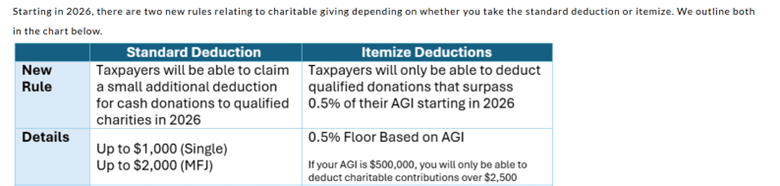
For taxpayers who itemize, consider bunching a few years’ worth of appreciated stock donations in one tax year. This can help get donors over the 0.5% floor and potentially reduce equity allocation and concentration in taxable accounts.
For individuals who take the standard deduction, consider making cash donations direct to eligible charities. Please note cash donations to Donor Advised Funds (DAFs) and foundations do not qualify for the additional deduction outlined in the chart above.
Additionally, for those 70 ½ and older, a Qualified Charitable Distribution (QCD) strategy allows individuals to donate up to $111,000 directly from their IRA to a charitable organization. The donation is excluded from Adjusted Gross Income (AGI) and can potentially put individuals into a lower tax bracket.
State and Local Taxes (SALT)
For taxpayers who itemize and qualify with the income phaseouts, the State and Local Tax (SALT) deduction has been temporarily increased from $10,000 to $40,400 in 2026, set to sunset in 2029. For individuals who can itemize, be aware of income phaseouts and when possible, consider deferring taxable income to maximize the SALT deduction.
529 Accounts
Starting in 2026, the withdrawal limit for Kindergarten- 12th grade doubled from $10k to $20k per year for qualified education expenses under Federal law. Please check your state laws for 529 qualified expense withdrawal rules. The OBBBA also made 529 accounts much more flexible and broader with qualified expenses. Unused funds can be utilized for other beneficiaries or potentially rolled to a Roth IRA.
Trump Accounts
Parents or guardians with eligible children born between 2025-2028 can elect to open Trump accounts via Form 4547 when filing their 2025 Tax Return or online. The $1,000 government seed money is expected to be deposited in July 2026.
Health Savings Accounts (HSAs)
As of 1/1/2026, Bronze and Catastrophic Affordable Care Act (ACA) plans are now HSA eligible accounts even if they do not meet the formal definition of a High-Deductible Health Plan. This change may create a unique opportunity for more individuals to save in HSA accounts and maximize triple tax benefits.
Taxpayers who itemize and are in the 37% income tax bracket will be limited to 35 cents on the dollar for their deductions starting in 2026 tax year.
Alternative Minimum Tax (AMT)
The AMT phaseout limits reverted to 2018 levels starting in 2026.
Qualified Business Income (QBI)
The 20% Qualified Business Income (QBI) deduction was made permanent under OBBBA. The QBI codification allows eligible self-employed and small-business owners to claim an income deduction from a qualified trade or business (up to 20%). In 2026, the income phase out limit increased from 2025.
Other changes under the OBBBA are explored in more detail in our previous OBBBA Blog.
Estate Plan Check Up
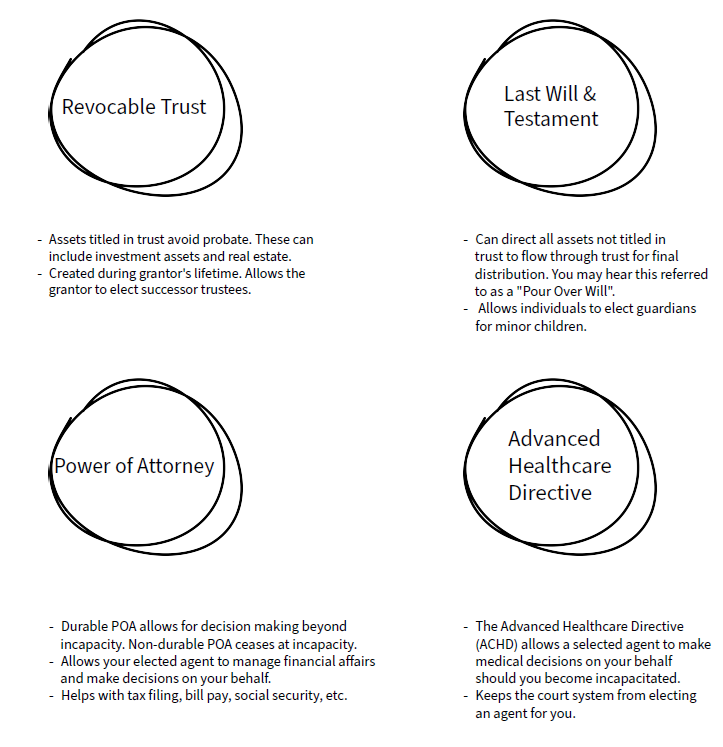
A new year always presents an opportunity to review your estate plan and beneficiary elections. We urge clients to check how their real estate assets are titled through their local county recorder or assessor’s office. Life changes may also create the need for beneficiary updates or a trust review.
Building upon the direction of assets, there are four key estate plan documents that most adults should have, including: a revocable living trust, will, power of attorney (POA), and advanced health care directive (ACHD).
How WAM Can Help
The Weatherly team welcomes the opportunity to connect and capitalize on 2026 planning opportunities, such as cash flow projections and analysis, asset allocation review, gifting to next generation and philanthropy, 2026 strategies under the One Big Beautiful Bill Act (OBBBA) and estate plan checkup.
As tax season approaches, Weatherly is also happy to coordinate document exchanges with your tax professional. Please reach out to our team to coordinate.
*Disclosures:* The information provided should not be interpreted as a recommendation, no aspects of your individual financial situation were considered. Always consult a financial professional before implementing any strategies derived from the information above.
After a historic 2024, the New Year provides an opportunity for people to check in with themselves about their personal and financial goals. Life events, career changes, and a new administration may create fresh opportunities for financial planning for you and your family. As we step into 2025, the financial landscape continues to evolve; shaped by shifting economic trends, emerging technologies, and changing personal priorities. Whether you’re planning for retirement or investing in your future, planning has never been more essential. This year brings new opportunities and challenges from navigating the investment environment to potential changes in the tax code. The following will explore some practical strategies and actionable tips and insights to help you make informed decisions towards achieving your financial goals this year and beyond.
Financial Plan/Health Check-in
Similar to checking in with your physical health, a new year provides the perfect opportunity to check-in on your financial well-being.
Unexpected medical events can be very costly if not planned for correctly. It is important to review health, disability, and long-term care insurances to confirm their best application to your situation.
- For those covered by high-deductible health insurance plans, the healthcare savings account (HSA) contribution limit for 2025 increased to $4,300 for individuals ($1,000 catch-up for individuals aged 55+) and $8,550 for families.
The WAM team also likes to review financial plans with clients on an annual basis for adjustments to assumptions on spending, retirement and outside account balances. Identifying “gap years” when income is lower can offer a variety of planning opportunities.
- If you are anticipating a lower tax year, you may want to explore a Roth conversion. The conversion allows a transfer from a Traditional IRA or 401(k) to a tax-free Roth after paying the deferred income tax.
- If you have an executive compensation plan including stock options, we can collaborate on when and how to exercise your options to minimize your tax liability.
Social Security analysis is integral to financial planning. If you are planning to work past full retirement age (FRA), it may be beneficial to defer collecting Social Security benefits. We elaborated on strategies relating to Social Security, Medicare and Medicare premiums in a previous blog.
Investment Portfolio/Rebalance
The financial plan and gap year analysis may also showcase years in which realizing capital gains or exercising stock options would come with a lesser tax bill.
- A new year brings a new slate for capital gains. Our team collects tax returns annually to review for long-term capital loss carry forwards and net operating losses (NOLs) to help with planning for taxable portfolios.
- Projected income from your investment portfolio can vary year-to-year. It is important to understand the projected income stream to have a solid grasp on inflows and outflows for the upcoming year.
- Identifying and planning for large or extraordinary cash flows in advance allows our team to be strategic about raising funds in the portfolios. We can also communicate capital gain implications with your tax professional throughout the year to ensure adjustments to estimated tax payments are made as appropriate.
- Changes in your financial picture may call for a review of your asset allocation or investment profile. Growing families, employment changes, and inheritances may provide changes to your cash flow needs and risk tolerance.
Retirement Planning/Income/Taxes
Individuals participating in active plans should be aware of new contributions and deferral limits for the upcoming year. The deductibility of contributions, phase outs and options for maximizing deferrals are key to review with your advisor annually.
- Traditional/Roth IRA – IRAs will have the same contribution maximum ($7,000 with an additional $1,000 for individuals over 50). However, Roth IRA phaseout limits have been adjusted slightly upward.
- 401(k) – Salary deferrals have been increased to $23,500 with the age catch-up remaining at $7,500.
- Defined Compensation Plans (DCPs) – All retirement plans categorized as DCPs (Profit Sharing Plans, 401(k), 403(b), Money Purchase, etc.) will see the annual Section 415 limit increased to $70,000.
- Defined Benefit Plans – All defined benefit plans will see the annual benefit limit increase from $275,000 to $280,000.
Revisit the withholding on your W-2. Changes in salary and outside income sources can potentially cause you to under withhold taxes on W-2 if not adjusted.
If you are over age 73 or have inherited an IRA, the start of a new year is the perfect time to review your required minimum distributions (RMDs) and tax withholdings.
- If you inherited an IRA after 2019, you may be subject to the 10-year rule. The IRS released new guidance, effective in 2025, on minimum annual distributions for non-spouse beneficiaries.
- If you are charitably inclined, qualified charitable distributions (QCDs) are a tax efficient way of giving for those over age 70.5. The QCD limit was raised from $105,000 previously to $108,000 in 2025.
Gifting Strategies/Education Planning
In 2025, the annual gift exclusion was raised to $19,000 for individuals and $38,000 for couples, allowing you to remove assets from your taxable estate while providing benefit to someone of your choosing.
- 529 Plans are education saving vehicles that allow you to front load with five years’ worth of the gift exclusion ($95,000 for individuals in 2025). Leftover funds may also be rolled over into a Roth IRA.
- Tuition paid directly to the institution is not included in the $19,000 gift exclusion calculation.
Charitably inclined individuals may benefit from the creation of a Donor Advised Fund (DAF). A DAF allows for the removal of appreciated securities from your estate without a tax event. You can also name the DAF as a beneficiary of your estate or IRA, removing assets from your estate value at passing.
- DAFs also offer the opportunity to reduce low-cost basis, single stock concentration in your portfolio without realizing capital gains.
Estate Planning
Similar to your beneficiary review, it’s important to review your estate plan on an annual basis to ensure any changes in family are incorporated and consistent with current estate and tax law.
- Life events such as marriage/divorce or birth of a child or grandchild may also call for an update to your primary or contingent beneficiaries.
- Ensure assets are titled correctly to avoid probate (if applicable in your state) during an estate administration. For example, ensure all brokerage accounts, bank accounts and real estate assets are appropriately held in a Trust or an LLC.
- Check in on old 401ks for consolidation opportunities or beneficiary updates if you recently changed jobs or retired.
With The Tax Cuts and Jobs Act (TCJA) set to expire at the end of 2025, the estate exemption would be expected to drastically decrease. While the new administration has signaled an intention to stall the sunset, it is important to align your estate tax eligible assets to achieve the most tax efficient outcome.
- Review the potential for gifting directly to beneficiaries or into irrevocable trusts with your advisor. You can get ahead by creating a plan to execute if or when laws change.
- You can utilize trust structures like Charitable Remainder Trusts (CRTs) to remove assets from your estate now, receive a charitable tax deduction and create an income stream for the remainder of your and/or your beneficiaries’ lifetime.
How WAM Can Help
Keeping your financial plan and goals up to date makes the financial planning process easier to manage and implement. Regular check-ins can help you avoid the stress of making large, last-minute changes to stay on track. At Weatherly, we’re committed to continuously refining plans and portfolios to benefit our clients while staying aligned with updates to tax and estate legislation. By staying informed about changes in the industry and the world, we can offer tailored advice that helps our clients and community adapt and thrive. Let’s work together to ensure your financial plan stays as dynamic as your life.
** The information provided should not be interpreted as a recommendation, no aspects of your individual financial situation were considered. Always consult a financial professional before implementing any strategies derived from the information above.
Weatherly Asset Management was established in October of 1994 as an independent investment advisor focused on wealth management. Looking back, the world as we knew it in the Fall of 1994 is nearly unrecognizable. In the 30 years since Weatherly was founded, we have seen the meteoric rise of the internet, adapted to 5 different presidential administrations, witnessed the launch of 4 out of 5 FAANG stocks, weathered a global pandemic and much more. While life is certainly different these days, one thing that has not changed is Weatherly’s comprehensive approach to all aspects of a client’s financial life, the extensive experience of our principals, and accessibility to experts on our team. In this month’s blog, we reflect on the past 30 years of WAM and how the world has changed with us.
The Weatherly Approach
Weatherly was founded 30 years ago with the same core pillars we have today – customized investment management and comprehensive planning for clients. Our accounts are managed with each client’s specific situation and goals in mind, utilizing individual stocks and bonds to maximize returns and tax efficiency. Our approach to financial planning has evolved with changing policies and market conditions over the past 3 decades, encompassing tax, family, and business planning and philanthropic strategies as well as wealth and estate guidance.
Our ultimate goal is to create meaningful impact in our clients’ lives so they can focus on their families, business and community.
THE FIRST 10 YEARS 1994-2004
In the early days of Weatherly, equity values grew exponentially as internet-based technology companies dominated the stock market. This period of massive growth and significant change set the stage for Weatherly’s beginnings. The Firm closing out its first decade serving 136 families with $100 million in assets under management.

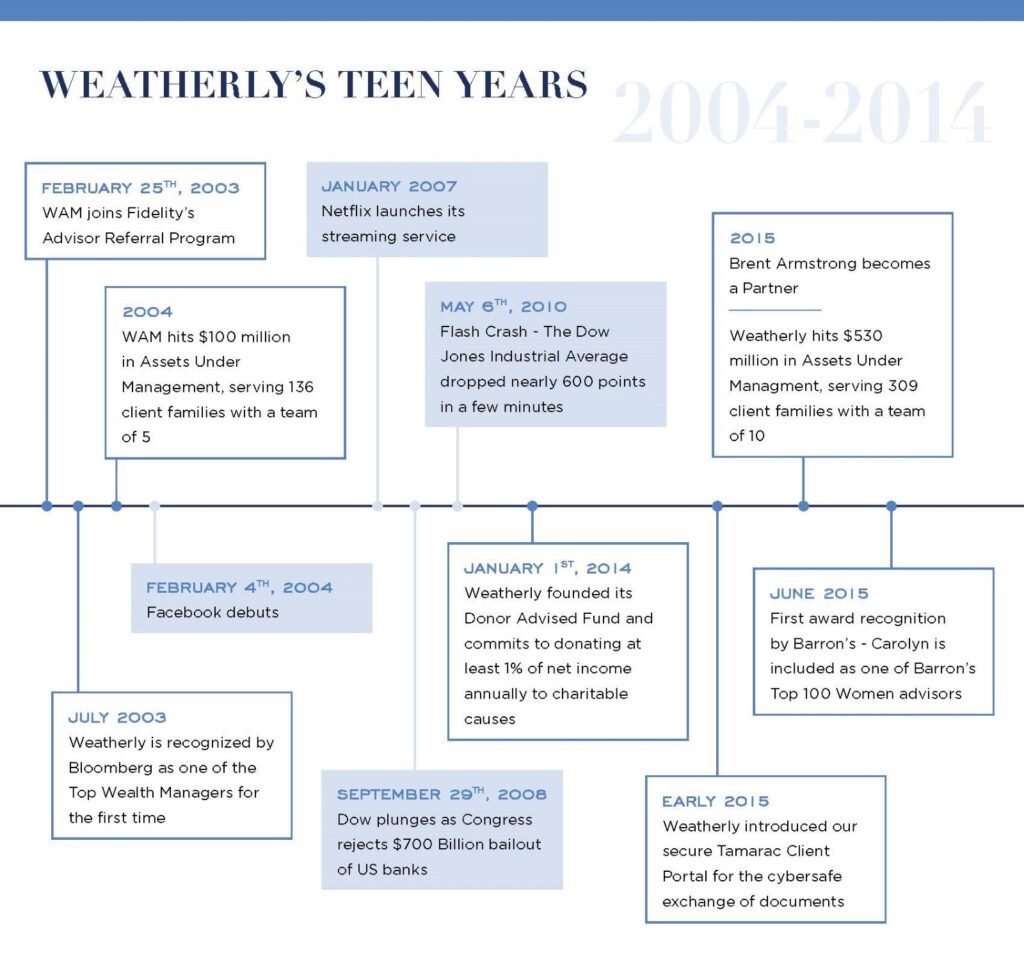
WEATHERLY’S TEEN YEARS 2004-2014
The second decade of Weatherly brought us household terms like “Gmail” and “iPhone” while we watched as both U.S and international markets experienced high levels of volatility during the 2008 global economic crisis. Netflix began its transition to streaming and Bitcoin shuffled cryptocurrency into the mainstream.
WAM’S ROARING TWENTIES 2014-2024
The mid-2010s-20s ushered in a new era at Weatherly, we added 4 Partners to Firm leadership, underwent a full rebrand of our logo and website, and made impactful advancements in technology infrastructure, but we weren’t the only thing changing. The past 10 years were filled with “unprecedented events” including Brexit, the rise of meme stocks, a global pandemic and much more.
Celebrating 30 Years
In honor of our 30th year in business, our team has dedicated extra time and resources to the growth and welfare of our community. To keep up with our community involvement, you can check out our Culture & Community page.
Donor Advised Fund
Weatherly annually gives back approximately 1% of net income via our Donor Advised Fund. This year each member of our team selected two charities to receive funds, for a total of 30 donations in addition to our regular annual commitment.
Event Sponsorship and Community Involvement
By year end, our team will have supported 30 local causes – either by volunteering time or philanthropic and industry sponsorships. We’ve given back in areas of food insecurity, environmental clean-up, and child and animal welfare amongst others and the continued development of our professional colleagues.
Thank You
Our team is very proud to celebrate our anniversary with the clients, colleagues and community that made our mutual success possible.
We were thrilled to host some of our clients at our 30th Anniversary Client Appreciation Event at Powerhouse Community Center in Del Mar for an evening of wonderful food, drinks and even better company. Thank you to all who were able to make it out for the evening, we wouldn’t have wanted to celebrate any other way!
** The information provided should not be interpreted as a recommendation, no aspects of your individual financial situation were considered. Always consult a financial professional before implementing any strategies derived from the information above.
In the journey toward financial security, the intersection of saving and spending plays a pivotal role- irrespective of income or assets. This blog post delves into the significance of a well-structured budget and offers key insights for those saving for retirement or already retired. It emphasizes the crucial steps individuals should take to secure their financial future, including strategies for pre-retirement saving and post-retirement withdrawal. Understanding these principles is vital for anyone aiming to nurture and grow their nest egg effectively.
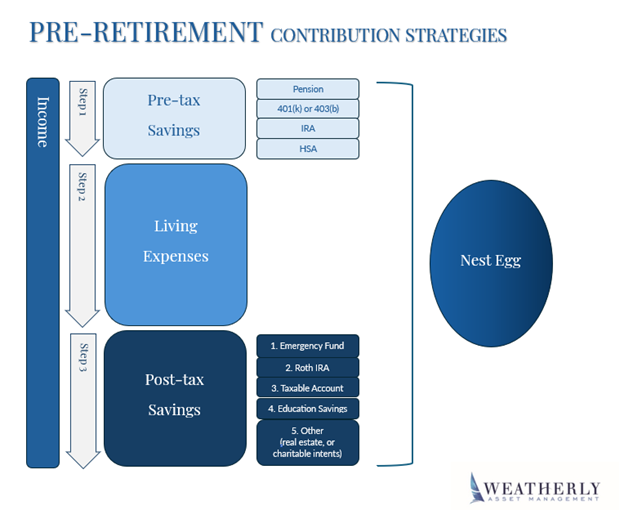
Saving Buckets Pre-Retirement
Step 1: Pay Yourself First
During your working years, it’s easy to overlook the importance of a detailed budget, relying instead on a regular paycheck to support your lifestyle. As careers progress and income increases, many people fall victim to lifestyle creep—spending more as they earn more without increasing their savings.
Fidelity advises aiming for a savings rate of 15% of your pre-tax pay, with the goal of saving enough to replace at least 45% of your pre-retirement income (Retirement Guidelines). While this is a recommended minimum, each household is different and retirement goals will vary. The motto “pay yourself first” is incredibly important. Setting up automatic, recurring savings to an employer-sponsored plan, such as a 401k or other pre-tax accounts like an IRA, ensures your income isn’t spent frivolously and helps reduce your taxable income. Depending on your employer, additional savings vehicles such as Health Savings Accounts (HSA) or Deferred Compensation plans may be available, allowing you to shield additional income from taxation and build your retirement nest egg. HSAs are particularly beneficial for healthcare savings, offering triple tax benefits: contributions are deductible, growth is tax-deferred, and qualified withdrawals are tax-free. Self-employed individuals have similar retirement options, which we explored in a previous blog post- Finding A Balance. Each of these plans have different annual contribution and income thresholds that can be found on the Key Financial Data chart.
Step 2: Understanding your Expenses
Once you’ve contributed to tax-deferred accounts, focus on managing your after-tax income for monthly living expenses and potential after-tax savings for investment accounts. Living expenses can often be broken down into two categories: non-discretionary and discretionary expenses. Non-discretionary represents expenses required to be paid, such as a mortgage, utilities, healthcare, or insurance. Discretionary expenses capture everything else that individuals or families spend to maintain their lifestyles. It’s common for people to mistakenly treat discretionary expenses as essential, such as multiple streaming services. Reviewing your monthly credit card statement can help identify unnecessary expenditures. Free online budgeting tools can categorize transactions, track spending, and provide insights into duplicative services. Taking the time to analyze your spending can uncover overlooked or frivolous expenses, enabling you to streamline your budget and optimize your savings.
Step 3: Prioritizing Post-Tax Savings Buckets
#1 Emergency Fund
First and foremost, we suggest clients save 3-6 months of expenses for unexpected events. Consider investing in liquid accounts like money market funds or high yield savings accounts.
#2 Roth IRA
Once the emergency fund has accumulated, look to tuck away money in a Roth IRA, if eligible. Roth accounts allow you to make after-tax contributions up to the annual contribution limit ($7,000 and additional $1,000 catch up contribution for those 50 and older in 2024). Roth accounts are attractive as the growth and qualified withdrawals are tax free for owners, beneficiaries, and are not subject to required minimum distributions.
Eligibility Requirements: To be eligible to contribute the maximum amount to a Roth IRA in 2024, your modified AGI must be less than $146K if single and $230K if married and filing jointly. Additionally, you or your spouse must have taxable compensation of at least your contribution amount. The income limits and contribution phase outs are further outlined on our blog post Keys to the Key Financial Data Chart.
#3 Taxable Accounts
Once an emergency fund has been established, contributions have been made to retirement
accounts (pre-tax and Roth), and HSAs are funded (if eligible), additional savings can be allocated to taxable accounts. Often this is in the form of taxable investment accounts- Trusts, Individual TODs (Transfer on Death), and Joint accounts. These accounts are attractive as there are no age-based restrictions and have favorable long-term capital gains rates for securities held for at least 1 year. On the other hand, portfolio income is taxed yearly.
Over time, maintaining a balance between funding retirement accounts and taxable accounts can provide greater flexibility in managing withdrawals and taxes. This mix ensures you have accessible funds for unexpected needs or opportunities while optimizing your overall tax burden throughout retirement.
When accumulated taxable accounts are in excess of needs, we began looking to educational accounts (#4) or charitable gift funds (#5). We will talk more about this below.
#4 Educational Accounts
Contributing to tax-advantaged education-savings accounts, such as 529s, can offer significant benefits to both you and the recipient. By leveraging the annual gift tax exemption amount ($18K per person, per individual for 2024), parents or grandparents can reduce their taxable estate while contributing to qualified educational expenses.
Funding Rules: In general, you can contribute up to $18,000 ($36,000 for married couples) per beneficiary per year without triggering federal gift taxes in 2024. However, special 529 rules allow you to front load five years of annual exclusions for a tax-free gift of up to $90,000 (joint taxpayers may fund $180,000). Refer to our blog post 5 Estate Planning Strategies for more information.
#5 Other
We include one last bucket as a catch-all for individual needs and goals. For those looking to diversify their net worth by investing in real estate, they can leverage funds from the taxable accounts. Investing in real estate can provide both rental income and potential appreciation in property value, which can be an effective way to build wealth and generate passive income.
Another common strategy we use with our clients who are charitably inclined is opening a Charitable Gift Fund. Donor-Advised Funds (DAFs) are a popular choice, allowing you to make a charitable contribution, receive an immediate tax deduction, and then recommend grants from the fund over time. This strategy provides flexibility in your charitable giving and can be a valuable tool for estate planning. Contributions to DAFs can also help reduce your taxable estate, which can be particularly beneficial for high-net-worth individuals. We go into more information here: WAM’s Guide to Giving.
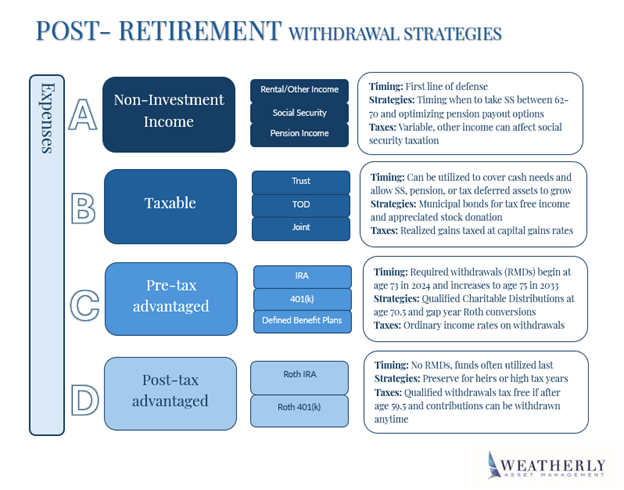
Post-Retirement Withdrawal Strategies
The shift from saving to spending in retirement can be challenging, underscoring the need for a comprehensive financial plan. We work with clients regularly on these plans and review withdrawal rates to maintain sustainable spending levels. It is important to customize your withdrawal strategy- focusing on tax efficiency while balancing factors such as age, income streams, assets, and estate goals. There is no universal approach, it is important to consider different income sources and account types over time for a more tailored strategy.
A. Non-Investment Income
If you have rental properties or other passive income streams, these should be your first line of defense for covering living expenses in retirement. Utilizing these sources can help preserve your investment portfolio, allowing it to continue to grow and support your financial needs in later years.
Two focused planning areas we often discuss with our clients revolve around Social Security and pension income. Deciding when to start collecting Social Security benefits can impact your retirement income. You can begin receiving benefits as early as age 62, but if able, delaying benefits until age 70 can significantly increase your monthly benefit. Evaluating your financial situation and life expectancy can help determine the optimal time to start Social Security. The same goes for pension payouts; to maximize its value, ensure payout options and survivor benefits are considered.
B. Taxable
Taxable accounts are generally the next step to tap into during retirement. These accounts offer favorable tax treatment on long-term capital gains or dividends and come with no age-related restrictions on withdrawals. By using funds from taxable accounts initially, you allow your tax-advantaged accounts more time to grow until RMD age.
C. Pre-Tax Advantaged Accounts
Starting in 2024, Required Minimum Distributions (RMDs) begin at age 73 and increase to 75 in 2033. Withdrawals from these accounts are taxed as ordinary income, which can significantly impact your tax bracket. Therefore, it’s crucial to strategize withdrawals to minimize tax liabilities. Understanding RMD rules and timing your withdrawals can help avoid hefty tax penalties and optimize your retirement income.
Withdrawal Restrictions: You can withdraw from these accounts without a penalty after reaching 59.5 years old. At age 70.5, you can make tax-free charitable donations directly from your IRA, which can satisfy your RMD (Required Minimum Distribution) requirements and reduce your taxable income. For more information on recent updates to Secure Act 2.0 read our recent blog Secure Act 2.0
D. Post-Tax Advantaged Accounts
Roth accounts are often saved for later in retirement or strategically leveraged by high earners due to their unique tax advantages. Unlike traditional retirement accounts, Clients over the age of 59.5 who have held their funds in a Roth account for at least five years can withdraw contributions and earnings tax-free. By delaying withdrawals from Roth accounts, individuals can allow their investments to grow tax-free for a longer period, maximizing their retirement savings. High-net-worth individuals may find Roth accounts advantageous for estate planning, as these accounts are not subject to required minimum distributions during the original owner’s lifetime. This feature allows for a more flexible and tax-efficient transfer of wealth to beneficiaries.
Conclusion
A well-structured contribution and withdrawal strategy is essential for a financially secure retirement. Prioritizing various income sources and understanding the tax implications of different account types optimizes retirement savings. We help many of our clients who are small business owners and executives prioritize income and wealth strategies through various personal and business transitions. There are many different planning opportunities available based upon various ages, life events, and individual’s personal situations that Weatherly can identify and plan for. Whether this involves running a full financial plan or isolating a particular scenario- we enjoy educating our clients and optimizing the right path forward.
** The information provided should not be interpreted as a recommendation, no aspects of your individual financial situation were considered. Always consult a financial professional before implementing any strategies derived from the information above.
In our 30-year firm history and experience working with clients, every person has unique planning opportunities to explore and consider throughout their lifespan. As a female-founded and majority owned firm, women have organically become a growing client group we service. In this blog post, we outline various investment and financial planning opportunities for women to consider, broken out over five life phases, with many strategies that can apply to all individuals.
Phase 1: Laying the Groundwork- Young Professional Phase
Make the most of your early career to earn what you are worth, establish good money habits and harness the power of compounding returns.
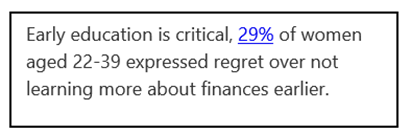
Source
The transition into the workforce marks a critical time for establishing financial independence. Healthy habit formation in these early years coupled with a few small strategic decisions, can have a significant long-term benefit. Some unique planning and investment opportunities to consider in this phase include:
- Budgeting: the 50/30/20 rule serves as a basic, easy to remember tool- of your net income, budget 50% for essential living expenses/30% towards wants, or discretionary spending- such as gifts to philanthropy/ and 20% towards savings and debt repayment.
- Pay yourself first: While you may be balancing student loans or other debt from pre-career, it is key to establish a 3–6-month emergency fund as early as possible. A separate account such as a High Yield Savings account for a portion of your paycheck to go into can be a simple solution to pay yourself first and start building your nest egg.
- Retirement account contributions: Familiarize yourself with your employer’s retirement account options such as traditional 401Ks and Roth 401Ks. Often, employers will match contributions up to a certain percentage or dollar amount. Best practice is to at least contribute enough to get the company match. As you progress through the Young Professional Phase and debt balances are repaid, try to max out retirement plan contributions.
- Roth IRAs and tax- deductible contributions to IRAs: Roth IRAs can also be ideal vehicles for those early in their career as they allow for tax-free growth over time and future withdrawals are typically tax free if certain criteria are met. There are some rules outlined in our Young Adult Checklist and income limitations outlined in our Keys to our Key Financial Data Chart that can impact eligibility for Roth IRAs contributions. For those who may be ineligible for Roth IRA contributions, tax deductible IRA contributions could also be an attractive option to explore.
- Health Savings Accounts (HSAs): For those who have a High Deductible Health Insurance Plan, a Health Savings Account (HSA) can be a way to defer pre-tax dollars to be used on various future healthcare expenses.
- Investing Funds: Once contributions are made to employer retirement accounts, Roths, IRAs, or HSA accounts, be sure to invest the monies for potential long-term growth. In the event you save additional money beyond your emergency fund, retirement assets and HSA account, consider taxable brokerage accounts to save and invest additional monies.
For women, this stage is also about understanding and negotiating for fair pay, reflecting their worth in the workplace, which is essential for setting a strong financial trajectory.
Phase 2: Career Advancement- Focus Phase
This period is crucial for establishing a strong financial foundation, assets are the key to building wealth over time, choose what you want to do and do it well.
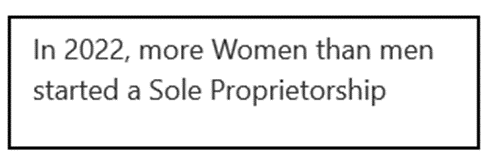
The second stage, or the “Focus” stage can be an ideal time for women to pursue entrepreneurial ventures or advance as an employee.
Women increasingly contribute to their growing economic influence- establishing successful businesses and acquiring stock options from publicly traded companies. Between 2020 and 2021, more than 49% of new businesses were started by women, up from 28% in 2019.
Some different opportunities for women in the Focus stage to consider, include:
- Mentorship: Regardless of the path, business is about people and connections. Seek out other women mentors on a similar career trajectory or on a path that you admire. Learn to establish connections and ask for advice.
- Entrepreneurs/Self Employed/Business Owners: For women who are self-employed or small business owners, decision making is limitless. We prioritize three key components to start on an entrepreneurial journey- business plans, business structure, and retirement accounts.
- Business Plan: an effective business plan can serve as a business roadmap and help with initial business funding. It can evolve overtime and drive your strategic planning, business growth, help manage finances, and strategize business exit or succession planning effectively.
- Business Structure: Sole-Proprietorships, Partnerships, S and C Corporations, and Limited Liability Companies (LLC) each have their own distinct tax implications, personal liability considerations, and operational complexities that we touch on in depth in the following blog post: From Start Up to Success: A Business Owners Journey
- Retirement Accounts: It is important to maximize after-tax income via retirement account. Some retirement plan vehicles to consider are Solo 401k, SIMPLE IRA, SEP IRA, Profit Sharing, or Defined Benefit Plans.
- Working Women: For women who work for small businesses, large corporations, or anything in between- education and understanding is key. Take the time to understand your entire employee compensation package as there is often more value than your base salary. This can include your base income, employer portion retirement contributions, healthcare benefits and employer paid premiums, bonus compensation, time off policies, life insurance policies and stock options. If you are granted stock options as a part of your compensation, there can be some complexities and unique tax implications, so it is important to consult with financial professionals for personalized advice.
Phase 3: Peak Earning Years and Asset Accumulation Phase
There is no one size fits all approach- focus on communication, clarity, and stability.
Often, women in this phase are in their peak earning years while balancing several responsibilities, from personal to partnering or parenting, while accumulating assets and managing finances. As women navigate this phase, it is important to think about your personal, financial and career goals with intention.
Some strategies we like to leverage are broken out here-
- Create an asset list: Create a list of your assets, which includes where they are held or custodied, the dollar amounts, title of each account, nature of the asset- community property or separate property, and key professionals to contact. In two party households, it is imperative for both partners to be engaged in financial decisions and knowledge transfer. This exercise not only helps educate both parties but can also serve as a resource in the event of an unexpected death or divorce. For two party or solo households, it can also be a starting point for planning opportunities, risk tolerance evaluation, and short- and long-term financial goals.
- Create an estate plan: Typically, all adults in this phase should have four basic estate planning documents: a trust, a will, power of attorney for healthcare, and power of attorney for finance. The asset list can be used to evaluate the need for community property trusts versus separate property trusts and which assets need to be retitled. It also creates the opportunity for self-employed women to create a personalized estate plan that intertwines with their business plan.
- Planning for Young Families: For women who have or plan to have families, there are some important steps to consider that we outline in our “Planning for Young Families” blog post.
- For women or a partner who decides to no longer work or stay at home, a Spousal IRA can also allow for maximized asset accumulation and growth.
Phase 4: Preparing for Retirement Phase
Make the most of your accumulated wealth and life experience to invest with confidence and purpose.
Approaching retirement, the focus shifts to maximizing employer benefits and solidifying income sources for a comfortable life post-career.
- Maximize Employer Benefits: Pre-departure from your employer, confirm which benefits may continue or may be portable to you. Some key considerations:
- Healthcare Insurance: Confirm if your healthcare insurance will continue or if you are eligible for COBRA. This is especially key if you are pre-Medicare age or rely on your current employer’s healthcare insurance coverage.
- Life Insurance: some employer sponsored life insurance plans may be portable meaning, you take over the policy and pay the premiums out of your own pocket. This may be an attractive opportunity to continue coverage versus securing a new life insurance policy.
- Stock Options or Equity Ownership: confirm if all shares- vested and nonvested- will remain intact or if any shares/ownership will be forfeited.
- Employer Retirement Plans and Pensions: some employer plans allow assets to be held within the employer, while others may require the assets rollover to an IRA, or others may allow you to choose. Additionally, pension plans typically have a wide range of pension income payout options- such as single life, joint survivor 100%, 25% or 50%- or lump sum. Evaluating the different options is key to maximizing retirement income, flexibility, and potential future investment growth.
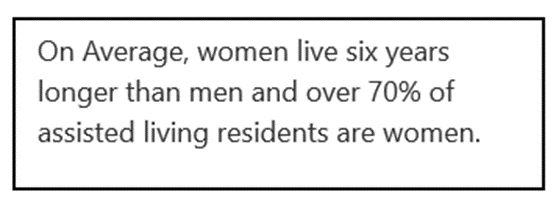
- Roadmap to Retirement: Given women tend to our live men, it is prudent to understand the ins and outs of Social Security, Medicare, and other retirement income sources becomes crucial; benefit optimization is key. Drawing from your different buckets of assets, in tax efficient ways, can also help maximize assets and help address longevity. Our Roadmap to Retirement Blog highlight several of these considerations in greater detail.
Phase 5: Successful Wealth Transfer Phase
Balance any desire to leave a legacy with a realistic plan for converting your savings into income, make your intentions clear and organize your assets.
By the end of this decade, a 2020 study found, women are set to control much of the $30 trillion in financial assets that Baby Boomer’s currently possess. Whether due to asset accumulation in working years, inheritance due to death or divorce, or longevity- women are gaining more economic power than previous generations. These circumstances coupled with women longevity, necessitates careful guidance from your team of professionals to ensure proper estate administration in the event of death or divorce.
- Planning for Successful Wealth Transfers: It is also key to revisit and keep estate plans and IRA beneficiaries up to date. A key question worth asking is what legacy do I want to leave behind for my family and/or to philanthropy? From there, there are some different strategies to consider such as annual tax-exempt gifting to individuals ($18K/person in 2024), and Donor Advised Funds (DAFs) and Qualified Charitable Distributions (QCDs) for tax efficient philanthropic giving.
Conclusion
In recent years, an unmistakable shift in the landscape of wealth accumulation and transfer has occurred, with women emerging as key drivers and beneficiaries. Weatherly stands at the intersection of these life stages, offering tailored advice, educational resources, and a supportive community to navigate the financial nuances each phase presents.
If this guide resonates with you or reminds you of someone in your life who could benefit from our services, we invite you to reach out. Together, we can build a financial plan that not only meets but anticipates your needs through every phase of life, ensuring a future of independence, security, and peace of mind.
** The information provided should not be interpreted as a recommendation, no aspects of your individual financial situation were considered. Always consult a financial professional before implementing any strategies derived from the information above.
Members of Generation X, particularly those who are business executives or owners, face several challenges in today’s world. They often find themselves caught between the demands of growing their business, raising their children, caring for their aging parents, and preparing for their own retirement. In this blog post, we focus on those in their 40s and 50s, who are uniquely positioned at the crossroads of planning for retirement, establishing a comprehensive estate plan, and supporting their families. Below we’ll explore effective planning initiatives, identify common financial hurdles, and offer strategic solutions to empower Gen X with the knowledge to navigate these critical financial decisions confidently.
Planning Initiatives for Gen X:
For Gen X entrepreneurs and executives who are navigating business finances alongside multiple personal obligations, it can be hard to take a step back and focus on their own health and well-being. That is especially true when it comes to their financial well-being, and it can be difficult to know where to begin. Identifying current financial obligations, long-term goals, and the steps needed to accomplish them can serve as a starting point.
For many, some shorter-term goals include managing monthly financial obligations while also assisting their children with college expenses. While some longer-term goals could include preparing for a successful retirement and ensuring their families are taken care of with an adequate estate plan in place. Whatever those financial goals are, the very first step is to identify them and begin outlining the necessary steps to achieve those goals.
While identifying your financial goals may seem like a simple task, understanding how to achieve those goals can get complicated. Many questions can arise as you progress on your financial journey such as:
- Am I saving in the most optimal way?
- Are there any pitfalls that I am unaware of from an investing or tax perspective?
- Do I need to make any changes now to ensure a successful retirement?
- Is my estate plan in good order?
- What if life or economic circumstances change and how will that affect my financial goals?
These questions coupled with the many obligations facing members of Gen X can be overwhelming. However, these questions can be addressed with comprehensive financial planning that considers both business and personal financial landscapes. For business leaders, this may include succession planning, and business valuation, alongside personal retirement planning and estate management. By engaging with a firm that is a fiduciary and has Certified Financial Planners (CFP) on staff, you can trust that you will receive non-biased financial advice that sets you up for success.
With a comprehensive financial plan, you can expect to engage with an advisor who will organize your finances in an easily digestible way. Through ongoing conversations, your planner learns more about your financial goals and values to model a roadmap for you and your family. Additionally, various scenarios can be implemented into your plan to account for the many dynamic factors that occur in one’s life. You can expect to receive personalized advice and concrete action items to ensure that you are on the path to achieving your financial goals. With the many obligations that members of Gen X face, delegating this aspect of their lives to a trusted financial planner can provide confidence and peace of mind.
Common Financial Challenges for Gen X:
Retirement Readiness:
A pressing concern for many in Gen X is the state of their retirement savings. According to a survey conducted by Bankrate 69% of Gen X workers feel they are behind on their retirement savings, and only 19% feel financially secure. Often caught between the needs of their children and aging parents, retirement planning can take a backseat. However, with retirement on the horizon, it’s imperative to take steps to bolster savings.
In general, the first step in achieving financial security is to ensure an adequate emergency fund. According to the CFP Board, it is recommended to have 3 – 6 months of liquid emergency funds on hand for unforeseen events. Once that has been fulfilled, the next step is to examine your cash flow needs to understand how much you can reasonably contribute to retirement accounts such as 401(k)s and IRAs. This exercise can assist you in identifying areas where you can cut expenses to maximize contributions to these accounts. When reviewing your retirement accounts there are some important factors to consider including but not limited to:
- Does a Traditional or Roth account make sense for me?
- Am I taking advantage of my employer match?
- Am I eligible to increase my savings with additional “catch-up” contributions?
- View our 2024 Key Financial Data Chart for additional information on retirement account contributions and catch-up amounts.
Utilizing retirement accounts to prepare for retirement is a great place to start on your path toward your financial goals. It is important to note that starting early is a key driver of success to take advantage of compounding returns over time. When considering your retirement account strategy, there can be several factors at play to determine the optimal way to save. By utilizing a professional financial planner, they can consider all the nuances of your financial situation to develop an optimal savings plan for you and your family.
Navigating Healthcare Before Medicare:
An often-overlooked aspect of mid-life financial planning is preparing for healthcare needs before becoming eligible for Medicare. For those in their 40s and 50s, especially business owners who might not have access to corporate health plans, this is a critical gap that requires strategic planning. The cost of healthcare can significantly impact financial well-being and retirement planning. It’s essential to explore health insurance options that bridge the gap until Medicare eligibility, such as private health insurance, health savings accounts (HSAs), or leveraging the health insurance marketplace for suitable coverage.
Investment Portfolio Considerations:
While building up retirement accounts is a primary driver of a successful retirement, it is also important to consider bolstering savings outside of these accounts. Building up taxable assets, such as a trust account or joint account, can provide many benefits as well. Unlike withdrawing from a retirement account where distributions are typically taxed as ordinary income, taxable assets are subject to capital gains rates which are usually taxed at a lower rate. By utilizing taxable accounts, you may be able to supplement retirement income in a tax-efficient way.
Moreover, for business executives and owners, equity compensation in the form of Restricted Stock Units (RSUs) or stock options represents a critical component of wealth. These instruments not only tie your financial success to the company’s performance but also introduce unique challenges and opportunities for tax planning and asset diversification. Effectively managing RSUs and stock options requires a nuanced understanding of vesting schedules, tax implications and the strategic timing of sales to align with your broader financial goals.
Another important consideration when discussing your investment portfolio is your time horizon and risk tolerance. These two factors are extremely important when considering the appropriate asset allocation within your portfolio. Time horizon refers to the amount of time that funds will be invested until ultimately needed for expenses. Said another way, time horizon refers to the amount of time you need your funds to last. Risk tolerance is a more subjective measure that refers to the individual’s comfort level with investment risk within their portfolio. These two factors together ultimately determine your portfolio’s asset allocation, which is the allocation to assets such as stocks, bonds, or other assets.
For members of Gen X, understanding their time horizon, risk tolerance, and existing asset allocation is a crucial step in the planning process. Depending on your specific situation it is important to consider your own financial goals and ensure that your portfolio is allocated accordingly.
To go one step further, it may be beneficial to understand each account’s individual asset allocation as well. For example, your taxable account may be invested more conservatively than your retirement accounts because withdrawals from your taxable accounts may begin sooner. Conversely, your retirement accounts may have a more aggressive allocation due to that account’s individual time horizon with required minimum distributions beginning at age 75 if you were born after 1960.
Lastly, as you move from your working years to your retirement years it is important to regularly assess your retirement needs and the asset allocation of your portfolio. Asset allocation decisions can change over time especially as you age. There can be many factors the influence a change to your investment portfolio, and with the help of an advisor you can trust that all the nuances of your life are taken into consideration.
Estate Planning for Gen X:
Estate planning is another area that can be often overlooked by members of Gen X. Without an adequate estate plan families can be left in difficult situations upon the death or incapacitation of a loved one. This is especially important for those families who have young children because a comprehensive estate plan can ensure their security if either parent were to experience an unexpected event. By having an estate plan in place, you can ensure that assets are distributed according to your wishes, ensure that your children are taken care of, and can significantly reduce the emotional and financial strain on a family during already challenging times.
In general, there are a few key documents that should be in place to establish an adequate estate plan:
- Trust: A trust can be used to protect assets, provide for minor children, and manage assets in the event of incapacity or death. Also, assets listed within the trust will avoid probate court, which can be lengthy and expensive. There are several types of trusts that can be useful depending on your specific situation and wishes.
- Will: A will is another important piece for an estate plan. With a will, you can designate beneficiaries, provide instructions for how and when beneficiaries receive assets, and name guardians for your minor children.
- Power of Attorney (POA): Establishing a trusted individual as your POA allows them to make financial and legal decisions on your behalf if you were to become incapacitated. If you become incapacitated and do not have a POA, managing affairs can involve lengthy court proceedings and be expensive.
- Health Care Power of Attorney (HCPOA): A HCPOA allows you to designate a trusted individual to make medical decisions on your behalf if you become incapacitated. This is a vital piece of an estate plan because it allows for your wishes to be followed in the case of a medical emergency, end-of-life care, or other healthcare decisions even if you cannot communicate them. This document can also provide clarity to family members regarding health care decisions to avoid any potential disputes.
The importance of estate planning cannot be overstated, especially for Gen X. Having a will or trust in place is critical for protecting one’s family and ensuring that assets are distributed as intended. Powers of attorney and healthcare directives are also essential, providing loved ones with the authority to make financial and medical decisions if one is unable to do so. Including aging parents in these conversations can also help ensure that their wishes are respected and that a plan is in place for their care and the transfer of their wealth. Our previous blog post includes helpful information on how to approach conversations around wealth transfer.
Supporting Your Children: Education Funding Strategies
With tuition costs these days, education funding is another planning opportunity for members of Gen X. It is important to consider starting early in the child’s life and exploring the various savings vehicles available. One of the most popular and widely used savings vehicles for education funding is the 529 account. There are two main types of 529 plans available for education funding:
- Prepaid 529 Accounts: With a prepaid 529 account you can prepare for future college tuition by paying today’s rate. With this type of account, families can purchase tuition credits with participating institutions that are typically based on current tuition rates. However, this type of 529 account is not very flexible when it comes to school choices, as they are often limited to in-state institutions.
- Education Savings Plan 529: With a standard 529 account families can open an investment account that can be used in the future for qualified education expenses. For example, items such as tuition, books, and room and board all qualify under this plan. Contributions are made to this account and grow tax-free and can be distributed tax-free for qualified education expenses.
Depending on your specific situation either account can provide an opportunity to set your child up for success when it comes to higher education. Also, family members such as grandparents can contribute to these accounts for your child’s benefit. There are several key items to note when discussing a 529 account:
- What happens if my child does not go to college? If your child does not end up going to a college or university, the funds can also be used for apprenticeships/trade schools or transferred to another child. Additionally, as of the Secure Act 2.0 529 accounts can be rolled over into Roth IRAs for the 529 beneficiary if certain requirements are met.
- Tax implications: 529 contributions occur after-taxes and are not federally deductible. However, depending on the state you live in, and if you use your state’s 529 plan, you may be eligible for state income tax deductions or state tax exemptions on withdrawals.
- Financial Aid: A 529 account is typically held by a parent or other family member and is not considered the child’s asset. Therefore, only a small portion of the account is considered during the financial aid process. If another family member such as a grandparent is the owner of the account, the assets won’t factor into the federal financial aid calculations.
While this is not an exhaustive list of items to consider when looking into a 529 plan, it is important to remember that starting early will increase your family’s preparedness for education expenses. Additionally, by including your children in the conversation, it can serve as a good opportunity to foster financial literacy and independence by teaching them about budgeting, saving, and investing to prepare them for their own financial futures.
How WAM Can Help:
As Gen X moves through mid-life, the opportunity to secure a stable and prosperous financial future is within reach. By focusing on key areas such as proactive savings, understanding your asset allocation, estate planning, and education funding, you can take steps today to lay the groundwork for a comfortable retirement. Here at Weatherly, our core pillars of service revolve around comprehensive financial planning and investment management. We are here to work with members of Gen X to construct a financial roadmap to assist them in achieving their financial goals. Additionally, our team of experienced portfolio managers are here to help develop an investment strategy that is in line with your goals and aspirations.
** The information provided should not be interpreted as a recommendation, no aspects of your individual financial situation were considered. Always consult a financial professional before implementing any strategies derived from the information above.
As we entered 2023, economic uncertainties and raising concerns about market volatility extended into the New Year. However, as the year progressed, markets rebounded, and earnings reports showed strength and resilience quarter over quarter. While Weatherly cannot control the economy, markets, or future tax environments, we can focus on helping our clients build well-structured plans to achieve financial goals.
We think the new year is an opportune time to pause and take inventory of your overall financial health. To help guide our clients along that process, we’ve outlined a framework with 20 key, tangible steps to consider.
Using the new year as an excuse to pause and perform a personal financial planning assessment allows individuals to optimize tax strategies, align financial goals with current circumstances, review and adjust investment portfolios, manage debts effectively, ensure financial security, assess retirement plans, and stay informed about relevant financial changes.
By taking advantage of the year-end period for a comprehensive financial review, you position yourself to start the new year with a well-informed and adjusted financial plan. Consider consulting your Weatherly advisor if you believe you could benefit from any of the following strategies.
** The information provided should not be interpreted as a recommendation, no aspects of your individual financial situation were considered. Always consult a financial professional before implementing any strategies derived from the information above.
Why is Equity Compensation Used?
In today’s competitive landscape companies of all sizes, both private and public, look for innovative ways to attract top talent. One of the most common ways in which companies entice employees to join their teams is through a special form of payment called equity compensation, colloquially referred to as stock options or stock awards. Equity compensation is defined as a form of non-cash compensation that awards an employee with stock (equity) in their company allowing them to participate in the ownership of their firm.
From a company’s perspective, equity compensation can provide many benefits such as:
- Attracting talent
- Retaining employees
- Performance motivations
- Conserving cash
There are also many benefits that equity compensation packages can provide an employee:
- Ownership Stake
- Alignment of Interests
- Potential wealth accumulation
- Potential tax benefits
While there are many benefits to receiving an equity compensation package, they can often be very complex and affect an individual’s financial plan from many different angles. Below we highlight the main types of equity compensation packages, their nuances, and important considerations for each.
The Types of Equity Compensation
There are many forms that equity compensation packages can take. The most common forms of equity awards are stock options, which can take the form of incentive stock options (ISOs) and non-qualified stock options (NQSOs), and restricted stock units (RSUs). Each vehicle carries its own nuances and mechanics that are important to consider for anyone’s financial plan.
Stock Options
Whether you are granted ISOs or NQSOs it is important to understand the mechanics in which stock options operate. Stock options allow the recipient the right, but not the obligation, to purchase company shares at a pre-determined price often referred to as the grant price or strike price. Since there is a pre-determined price options will only have value if the value of the company is higher than the grant price. If that is the case, an employee has the option to purchase company stock at a discount which can potentially provide enormous financial benefits.
It is important to note that stock options are a formal contract between employer and employee with specific rules and stipulations. The contract will clearly define the vesting schedule, the grant date and price, rules surrounding when an employee can exercise the options, and more. Below is a general outline of the stock option lifecycle.
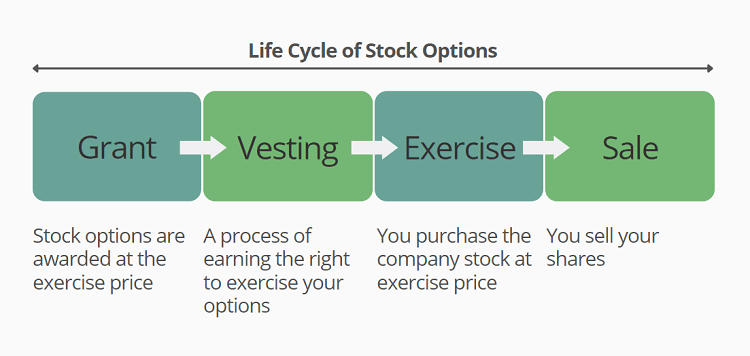
Also, within the contract the company will define which type of option they are granting the employee, an incentive stock option (ISO) or a non-qualified stock option (NQSO). The type of option offered to an employee can have a major impact on their overall financial plan and decision-making.
Incentive Stock Options (ISOs):
Incentive or Statutory Stock Options can provide the opportunity for preferential tax treatment if certain requirements are met. This benefit can potentially provide enormous savings as gains are taxed at capital gains rates rather than ordinary income tax rates. With an ISO package, there are items to consider before you exercise or sell the stock.
Important considerations with ISOs:
- Holding Period Requirements & Taxation: To receive the preferred tax treatment with ISOs, an individual cannot sell their stock within 2 years of the grant date and the stock must be held for at least one year after exercise. If an individual sells their ISO shares before meeting the required holding period, this is referred to as a disqualifying disposition and any gains will be taxed as ordinary income rather than long-term capital gains. Visit Weatherly’s Key Financial Data Chart for 2023 for a more detailed breakdown of tax rates and capital gains rates.
- Alternative Minimum Tax (AMT): Although ISOs offer preferential tax treatment, it is important to mention that an AMT adjustment may be necessary upon exercising options. With ISOs you may need to file an AMT adjustment on the “bargain element”, the difference between the fair market value of the options and what you paid for the stock (the grant price/strike price).
- $100,000 Per Year Limitation: Per the Internal Revenue Code 422(d), the fair market value of stock exercised in any calendar year cannot exceed $100,000. Anything in excess of $100,000 will be treated as a non-qualified stock options (NQSOs).
- Estate Planning: Generally, an individual is not allowed to transfer or gift ISOs during their lifetime, and if they do, that could potentially disqualify them as ISOs which forfeits the tax benefits. However, ISOs can be transferred upon an individual’s passing to their heirs or beneficiaries through their estate.
Non-Qualified Stock Options (NQSOs):
Non-Qualified Stock Options are the most common form of stock option offered in equity compensation packages. NQSOs are much simpler in nature relative to ISOs, they have straightforward tax events and are not subject to the same stringent rules. The major difference between NQSOs and ISOs revolves around taxation because gains from NQSOs are taxed as ordinary income rather than long-term capital gains rates.
Important considerations for NQSOs:
- Tax Implications: When you exercise NQSOs the difference between the grant price and the fair market value of the stock is treated as ordinary income. With NQSOs, you will owe taxes in the year you decide to exercise your options.
- Holding Period: Once exercised, depending on the length of time you hold onto your company stock you may be subject to either short-term or long-term capital gains rates.
- Timing of Exercise: Since taxes are owed in the year you exercise your options, it is important to consider your entire financial situation in order to minimize your tax liabilities. Weatherly often works with our clients’ tax team in order to ensure that our clients are utilizing their stock options optimally.
- Estate Planning: NQSOs are generally more flexible when it comes to gifting to heirs, family members, or other individuals than ISOs. During an individual’s lifetime, subject to rules from the employer, NQSOs can be easily gifted or transferred to family members, heirs, or beneficiaries.
How to Exercise Stock Options:
Both ISOs and NQSOs can potentially provide significant financial benefits to employees based on the ability to purchase company shares at a pre-determined price which would ideally be lower than the market value when exercised. When preparing to exercise options, it is important to keep in mind any specific blackout periods imposed by your company that dictate when and when you cannot exercise or trade company stock. Most importantly, with stock options, the employee is responsible for funding the purchase of their shares, and oftentimes this can mean a significant outlay of cash. Our team at Weatherly can assist you in navigating your choices when it comes to exercising your options. We can walk you through your options and tailor the advice to your specific situation considering cash flow needs, investment assets, and financial goals to ensure that you make a well-informed decision. Below we highlight the most common strategies when it comes to handling stock options:
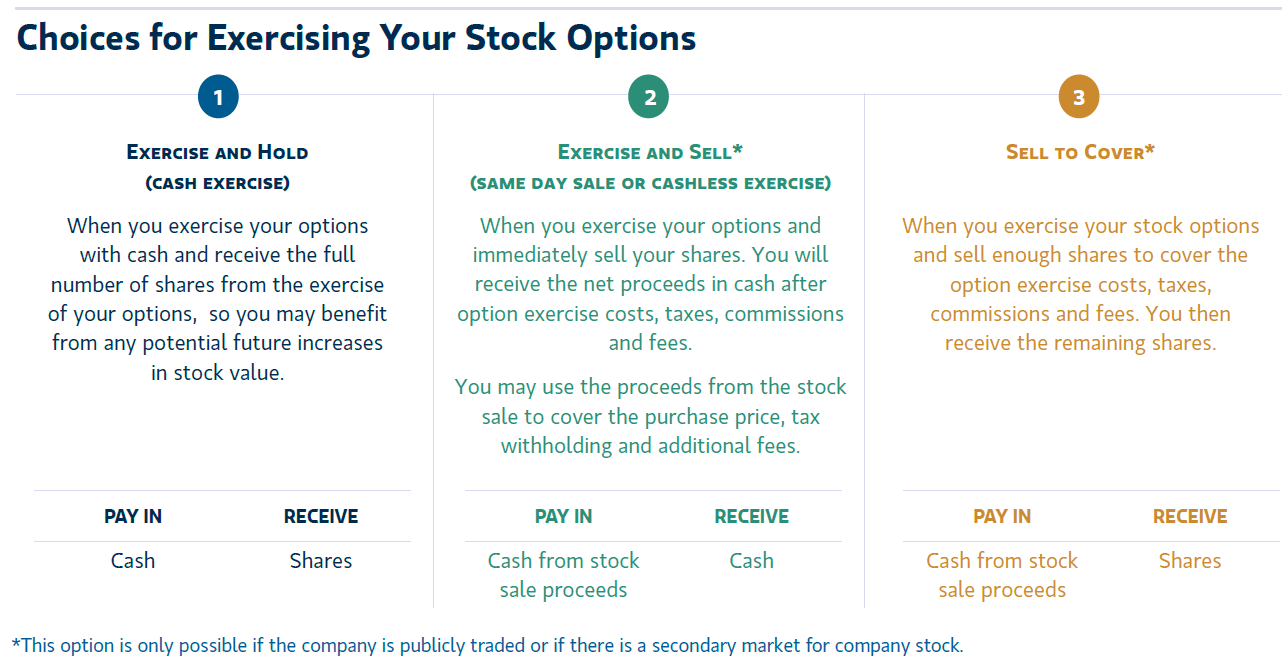
Sourced from: https://www.morganstanley.com/cs/pdf/NQSO-Basics.pdf
Restricted Stock Units (RSUs):
Restricted stock units are another common form of equity compensation offered by companies. With this form of compensation, a company will provide an employee with a specified number of shares at a future date. Like stock options discussed above RSUs are granted under a vesting schedule for a specified period of time or can be tied to performance metrics. Unlike stock options, RSUs are delivered outright meaning that there is no choice granted to the employee with regards to receiving shares. RSUs are converted to stock and awarded on a set series of dates during a vesting period, and once delivered the employee can then decide whether to hold or sell the shares.
Important considerations for RSUs:
- Taxation: With RSUs, you are taxed when the shares are delivered on the specified vesting date. Taxation is based on the market value of the shares received and is treated as ordinary income. Typically, a company will withhold a certain amount of shares for tax purposes, and you will receive the net amount of shares thereafter.
- Holding Period: Once the shares are received the employee has the decision to either sell the shares immediately and receive cash or hold the shares as part of their investment portfolio. If shares are sold immediately there will likely be minimal to non-existent capital gain considerations. If shares are held then any increase in the fair market value from the time shares are received to when they are ultimately sold will be subject to either short or long-term capital gains taxes.
- Estate Planning: While RSUs are subject to vesting, they cannot be transferred or gifted to heirs or beneficiaries. Once vested and shares are delivered to an individual, they can be included as part of an estate plan and pass through to heirs and beneficiaries according to an individual’s estate planning documents.
Important Considerations for Your Financial Plan:
At Weatherly we have a team of dedicated professionals with deep knowledge and experience in the world of equity compensation packages and how to utilize them optimally to accomplish a client’s financial goals. We often work with our clients outside financial team of tax advisors and estate planners to coordinate the various moving pieces when it comes to receiving RSUs or exercising and managing stock options. From a financial planning perspective there are several factors to consider if you have an equity compensation package.
- What do I own?: Often times equity compensation packages may include a combination of ISOs, NQSOs, or RSUs. It is important to identify the various types of vehicles that are provided to you by your employer because there are various implications for your personal financial situation. Our team at Weatherly will request all the documentation associated with your equity compensation package to understand your benefits to begin implementing a plan appropriate for you.
- When do I pay taxes?: With the various vehicles available in an equity compensation package it can be very confusing to keep track of all the various tax implications and the timing of when taxes are owed. Our team of financial advisors often consults with your tax professionals to ensure that all parties are on the same page. We want to ensure that you have a clear picture of how exercising your options or receiving your RSUs will affect your tax liability.
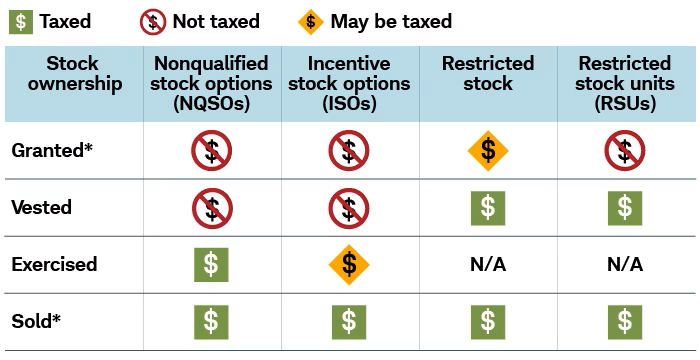
- How does my equity compensation package affect my overall portfolio?: If you are receiving stock awards as part of your overall compensation, those awards need to be considered when it comes to your overall investment assets. Decisions regarding selling the shares and holding the shares, and the timing associated with that, can have major implications to your overall portfolio and asset allocation. There may come a point in time where you have been awarded a sizeable amount of company stock which could expose your portfolio to concentration risk and lack of diversification. Our portfolio managers at Weatherly have extensive experience and strategies for navigating your stock awards in the context of your overall financial situation.
- How do my stock awards affect my overall financial plan?: Each client is unique with their own financial situation and goals. At Weatherly one of our core pillars is customized holistic financial planning. Our team of financial planners can incorporate your equity compensation package into your overall financial plan to understand how your stock awards can potentially impact your financial situation. Oftentimes times we run various scenarios providing our clients with different options they can take in order to ultimately achieve their goals and aspirations.
Our team of dedicated advisors at Weatherly are here to answer your questions and ensure that you are making informed decisions regarding your equity compensation package. We are here to understand your specific needs and circumstances to ensure that your financial goals and aspirations can become a reality.
** The information provided should not be interpreted as a recommendation, no aspects of your individual financial situation were considered. Always consult a financial professional before implementing any strategies derived from the information above.
Making decisions about your financial life can be daunting and difficult no matter the stage, but the choices you make now can have a major positive impact over time. Whether you are just thinking about getting started with professional financial advice, actively interviewing candidates or even heading into a quarterly review with your current advisor, discussing the right topics can offer you great peace of mind.
At Weatherly, we encourage open dialogues and value honest communication at every stage of our relationships with our current and prospective clients, their families, and their trusted professionals. We sat down and created a comprehensive list of questions that not only covered the basics, but also looked beyond at the relationships we build and the extent of the work we accomplish together. These questions are not only useful in the “due diligence” phase of interviewing, but impactful to review at least annually with your Weatherly advisor.
- Are you a Fiduciary and what does that mean?
A Fiduciary is a term in the financial services industry that refers to a financial advisor that serves under fiduciary duty, meaning that the advisors have pledged to make recommendations or collaborate with you on solutions with your best interest in mind, not for their own personal gain or financial benefit. You can learn more about our commitment to our fiduciary duty and view our regulatory filings on our ADV, Compliance and Disclosures page.
- Who is your custodian?
Weatherly primarily uses Fidelity Investments, but also works with Charles Schwab, and National Advisors Trust Company as custodians for client accounts. This separation of RIA (Registered Investment Advisor) and custodian is in place to protect the investor from loss or misuse of funds due to the Investment Advisers Act of 1940 as well as subsequent updates in 2009 by the Securities and Exchange Commission in the aftermath of Bernie Madoff’s Ponzi Scheme. A benefit of this distinction for clients is “side by side” reporting. As a client, you receive reporting directly from Weatherly focusing on investment performance and separate reports from your custodian, allowing you to cross-reference for additional transparency on account activity.
The importance of choosing the right custodian to work with is paramount to both your experience as a client and the safety of your assets. High quality custodians will be protected through SIPC insurance and even go above and beyond for investors by providing additional coverage, like the expanded comfort that Fidelity offers through Excess of SIPC insurance. In addition to annual reviews, Weatherly performs ongoing due diligence on third parties, including custodians, their insurance, and areas of potential risk. Weatherly prides itself on extensive vetting of our custodians to ensure the highest level of service for our clients.
- How do you make money?
Our comprehensive list of services is extensive, but Weatherly’s two core competencies are investment management and financial planning. Using these two pillars as a foundation, our team works with you and your trusted team of professionals on all aspects of your financial life from customized portfolio management to business, estate, retirement, and tax planning. For this holistic service approach, Weatherly charges a fee based on Assets Under Management (AUM,) 1% for equities and .5% for fixed income. We do not charge hourly fees for planning or other advice; our services are covered by your quarterly fee. For more information on our services and fees, you can review our Firm’s Form CRS.
- Who is your ideal client, do I fit in?
While we do not limit ourselves to these categories, organically over time our client base grew into three main groups with whom we feel we do our best work. Our three niches are Entrepreneurs and Small Business Owners, the Working Wealthy and Women. Each of these groups presents unique planning opportunities and their own unique complexities.
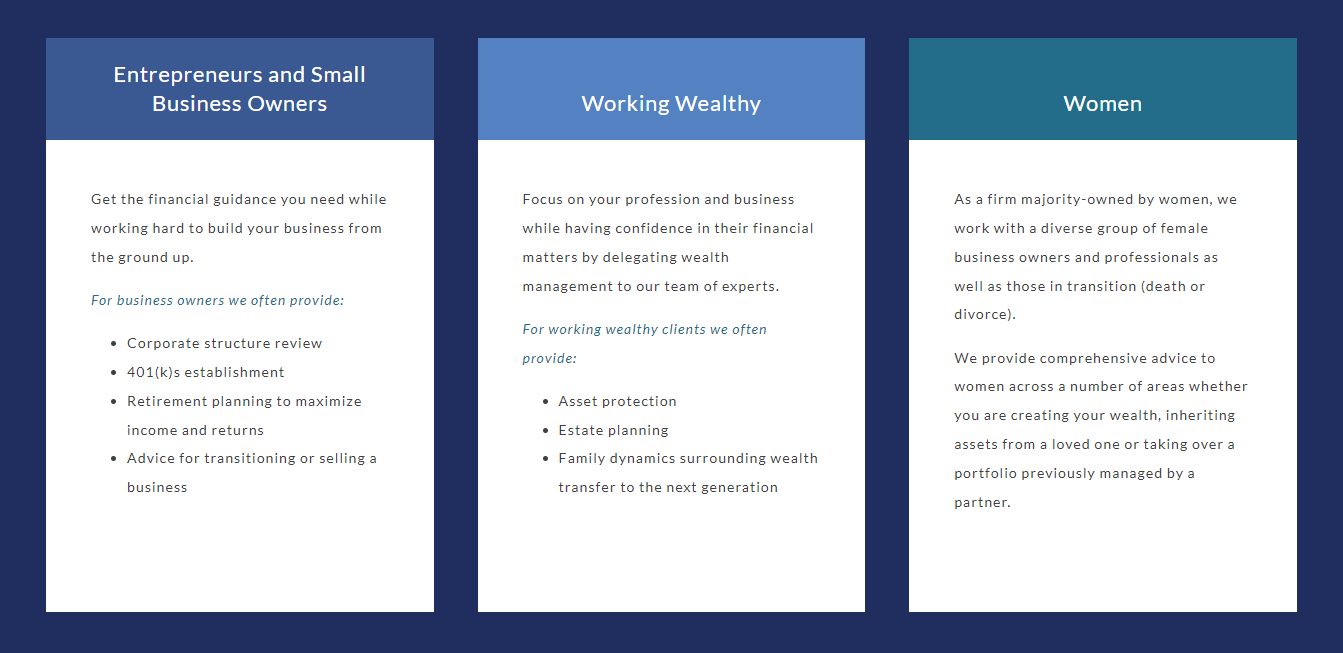
For an in-depth case study on the first of these groups, check out the first installment of our Weatherly Client Series.
- How often will I hear from you if I become a client?
Weatherly aims to have full reviews with clients quarterly, though we do not limit conversations to this cadence. Our team-based approach ensures that you always have access to a professional familiar with your financial picture via phone, email or dropping by the office. Depending on each individual client’s situation, we may look to increase the frequency of communication beyond quarterly. New client relationships often require a higher volume of conversation as we get to know your full financial picture, align, and implement our efforts to achieve your goals through our core competencies of investments and financial planning.
Also, life changes such as job transitions, business succession and opportunities, new children, the loss of a family member, marriage or divorce are all catalysts for more frequent communication. These events are impactful in all facets of life, but our advisors are here to lean on throughout these changes and ensure your financial world evolves to support your current situation.
- What are you and your team’s qualifications?
Under Carolyn’s leadership, Weatherly’s partners’ and team members’ commitment to education is top tier amongst local and national averages, enabling best-in-class continuity of client service. 100% of Weatherly’s staff has a minimum of a bachelor’s degree, with several team members holding post-graduate degrees. In addition, our team consists of multiple CFPs, a certified CPA, and multiple team members with industry-related subject matter specific credentials. All investment and planning-focused team members hold either a Series 65 or Series 7 license*. We lead by design in our industry for focusing on perpetual innovation, technology, mentoring, and human capital development.
Our team fosters a culture of education and evolution by prioritizing asking questions, sharing knowledge and ongoing collaboration with our clients, each other, and centers of influence in our professional community. You can read more about each team member, their background, and their qualifications on Our Team page.
- What is your investment philosophy and how do you pick positions?
Weatherly’s investment strategy focuses primarily on individual equity and fixed income securities and may use ETFs (Exchange Traded Funds) or no-load mutual funds for diversification in select sectors. We take a thematic approach to security selection, first identifying areas of potential through ongoing research and collaboration of our investment committee, then drilling down to determine specific companies where we see opportunity or risk. Our focus on individual securities lends itself to reducing overall fees a client pays in the form of expense ratios. Client portfolios typically include a mix of growth and dividend paying stocks, both domestic and international. For fixed income, we monitor yield curves for areas of opportunity and will deploy capital to maximize after-tax return while managing duration and credit risk. Fixed income investments may include Treasuries, Agencies, CDs, investment grade municipal and corporate bonds. Each client portfolio is managed to target asset allocation guidelines with flexibility to deviate plus or minus 10%.
Beyond general asset allocation guidelines, our security selection for each individual account and family aims to incorporate factors like retirement time horizon, withdrawal needs, saving rate, tax implications and business and community goals. These variables, among others, work in conjunction with your financial plan, which is monitored and adjusted as your situation evolves. Our goal is to determine the most attractive after-tax, after-fee return for you and your family, and let that factor into security selection, achieving solid long-term returns while also adapting to your risk tolerance and ongoing needs.
- How do you collaborate with my trusted professionals?
Weatherly works closely with a client’s team of professionals on all aspects of their financial life. Our team approaches planning and investment management with a broad and encompassing lens, considering estate, business, tax planning and much more. We view having a team of experts working on your behalf as essential. If you do not already have professionals in place, Weatherly taps into its network of highly qualified COIs to provide referrals that would be the best fit for your individual situation.
Given the breadth of information we gather and the intimate relationship we have with each client, our advisors are often the catalyst in development of specific strategies and can help further refine questions or simply talk through an issue before heading to your CPA (Certified Public Accountant) or attorney. We always recommend getting guidance from your trusted professionals, but it can be helpful to workshop scenarios with an advisor prior, to achieve total alignment as we work towards your goals.
- How can you help me stay on track with my goals?
Our planning model begins with a Dialogue for Impact. We believe that the value of our advice is driven by the amount we can learn about your individual situation. We appreciate the interconnectedness of life and livelihood and the dynamic nature of planning beyond just your finances. We begin with a comprehensive financial plan, considering your current situation as well as your future goals and run through multiple scenarios to determine the best options. Through quarterly update conversations with you (along with your family, and your trusted professionals as needed) we adapt the plan, provide recommendations, and implement solutions to ensure the health of your plan.
In line with planning, our team provides best practices and works directly with you, often one-on-one, setting up and maintaining healthy cybersecurity habits. Protecting your personal data is our priority, and our team employs elevated technology like our secure Weatherly portal to ensure your privacy. Our client service team is skilled in both teaching and technology to guide you along this journey.
As with most aspects of our service, we favor a comprehensive approach to planning for impact. Incorporating the next generation into ongoing dialogues can set you up for success as you age and ensure your goals and wishes are met even after your passing.
- How do you work with the next generation?
We consider working with the next generation to be a vital part of our long-term relationship and what we build together for clients as their advisor. Spanning our professional financial advice across generations can be one of the most impactful gifts you can give to both your loved ones, and your own peace of mind. Whether you are contributing to a 529 or UTMA account, helping a first-time home buyer or even ensuring clarity of your wishes in the event of a health crisis or your passing, our team is here to help.
To assist with this, as part of our onboarding, Weatherly has each client fill out what we call a CIRAL (Client Information Release Authorization Letter). This document helps our team support you and your loved ones in times of transition by indicating your team of trusted professionals, family members, and emergency contact and giving Weatherly permission to communicate with them on your behalf if it is in your best interest to do so.
Final Thoughts
Armed with these questions, you can enter a discussion with your advisor at Weatherly knowing that you will have all the answers you require on your side and the knowledge that you have us in your corner through all of life’s evolutions. Change is constant, but you can rest assured with Weatherly as a resource to help you outline optimal choices, detail benefits and drawbacks and help you make informed decisions as you enter new stages of life. Our team utilizes data, tax and legal guidance and innovative technology to ensure your path forward is the right one for you, your family, business, and community.
If you are still deciding to seek professional financial advice, it can feel like a big decision, yet considering these options can help ensure you are aligned with your chosen team. At Weatherly, we aim to inspire that confidence and foster transparency and alignment through the work we do with each of our clients so they may go on to achieve a positive impact on their families, businesses, and communities.
** The information provided should not be interpreted as a recommendation, no aspects of your individual financial situation were considered. Always consult a financial professional before implementing any strategies derived from the information above.
*updated 2024
The Secure Act 2.0 is the newest version of the Setting Every Community Up for Retirement Enhancement (SECURE) Act, which was originally signed into law in December 2019 and recently updated in December 2022. It is important to note- the Secure Act is designed to help Americans save for retirement and will create more flexibility for retirement savers. These 92 provisions will make it easier to access retirement savings and increase the amount one can save for retirement. Additionally, the Secure Act 2.0 provides incentives for employers to offer retirement plans by expanding employer benefits and tax credits. In this blog, we will review the six key features of The Secure Act 2.0, its effect on clients, and how Weatherly can help navigate the planning opportunities that are created.

The Secure Act 2.0 is an important piece of legislation that has been passed to help Americans save for retirement. One of the most significant changes included in the act is the increase of the Required Minimum Distribution (RMD) age from 72 to 73 in 2023, and eventually to 75 (in 2033). This change is beneficial to older Americans, as it allows them to keep more of their money in tax advantaged retirement accounts for a longer period. The new rule will also help those who are still working to have more time to save and invest, increasing their chances of having a secure retirement. Additionally, the penalty for not taking an RMD from a qualified plan or IRA has been lowered from 50% of the required amount not taken to 25%. If an untaken RMD is corrected in a “timely manner” the excise tax could even be reduced from 25% to 10%.

Another major development in the retirement savings landscape is the elimination of required minimum distributions (RMDs) from Roth accounts within 401(k) and other defined contribution plans. As a reminder, a “normal” Roth IRA account is never subject to RMD unless inherited, this is only in reference to 401(k) and other DC Plan Roth accounts. This means that individuals can now save more of their retirement funds for the future without having to worry about meeting RMD requirements. Additionally, the Act allows employers to make matching contributions to their employees’ Roth accounts (after previously only allowing pre-tax). This provides added incentive to save for retirement, giving individuals more flexibility and control over their retirement savings and allowing them to better plan for their future.

The Secure Act 2.0 has increased catch-up amounts in employer retirement plans for individuals aged 50 or older. This means that those individuals can make catch-up contributions to their 401(k), 403(b) or 457(b) plans, up to a limit of $7,500 for 2023. Starting in 2025, the limit is raised to 50% more than the regular catch-up limit for individuals aged 60 to 63. This is a major step in helping individuals save for retirement and ensuring that they have enough funds to live comfortably in their later years.
For more information please refer to Weatherly’s Key Financial Data Chart

Beginning in 2024, the Secure Act 2.0 has a provision that states if an individual’s income is over $145,000, any catch-up contributions made to their retirement savings accounts must be Roth contributions. Roth contributions are made with after-tax dollars, meaning that the contributions are not tax-deductible. However, the money grows tax-free and can be withdrawn tax-free in retirement. This provision of the Secure Act 2.0 is intended to help individuals save more for retirement, while also providing tax benefits.

The Secure Act 2.0 has introduced an exciting new planning opportunity for parents wanting to balance retirement savings with college savings. 529 education accounts can now be rolled over to Roth IRAs for 529 beneficiaries, tax and penalty-free, if the 529 account has been open for at least 15 years. To avoid manipulation of the new rule, the 15-year clock is reset every time a beneficiary on the 529 is changed. The annual rollover amount is limited to the annual Roth contribution amount ($6,500 for 2023) and the rollover must be from earned income. Furthermore, there is a maximum lifetime rollover amount of $35k. This new provision provides a great opportunity for parents to plan for their children’s college expenses while also saving for their own retirement.

A QCD allows individuals who are 70.5 or older to donate up to $100,000 directly to one or more charities from a Taxable IRA instead of taking their RMD. Under SECURE 2.0 the QCD rules are expanded to allow for a one-time $50,000 distribution to a charity through a split-interest entity. This $50K distribution can go to one of the following- charitable gift annuities (CGA), charitable remainder unitrusts (CRUT), and charitable remainder annuity trusts (CRAT). Beginning in 2024, the $100K annual limit on QCDs will be indexed for inflation.
For more information on QCDs refer to WAM’s previous blog – Guide to Giving
Bonus – Impact on employers – auto enrollment 401(k) 403(b)
The Secure Act 2.0 includes a provision for auto enrollment in 401(k) and 403(b) plans. This means that employers now automatically enroll their employees in these retirement plans, unless the employee opts out. This is a great way to encourage employees to save for retirement, as it removes the burden of having to actively sign up for a plan. Additionally, employers can also choose to increase the default contribution rate over time, which can help employees save more for retirement. This provision of the Secure Act 2.0 can be a great way to help employees save for retirement and ensure that they are able to retire comfortably.
In Conclusion
Overall, the SECURE 2.0 is an important step forward in helping Americans save for retirement and secure their financial future. These new rules will continue to change retirement savings and retirement plan distributions over the next few years. We will continue to remain diligent in how that affects you as our clients and individuals. These provisions can be complex and everyone’s financial situation is different, reach out to your Weatherly Advisor today to learn more about how the Secure Act 2.0 changes apply to you.
Timeline of rollout and enforcement of provisions, see attachment:
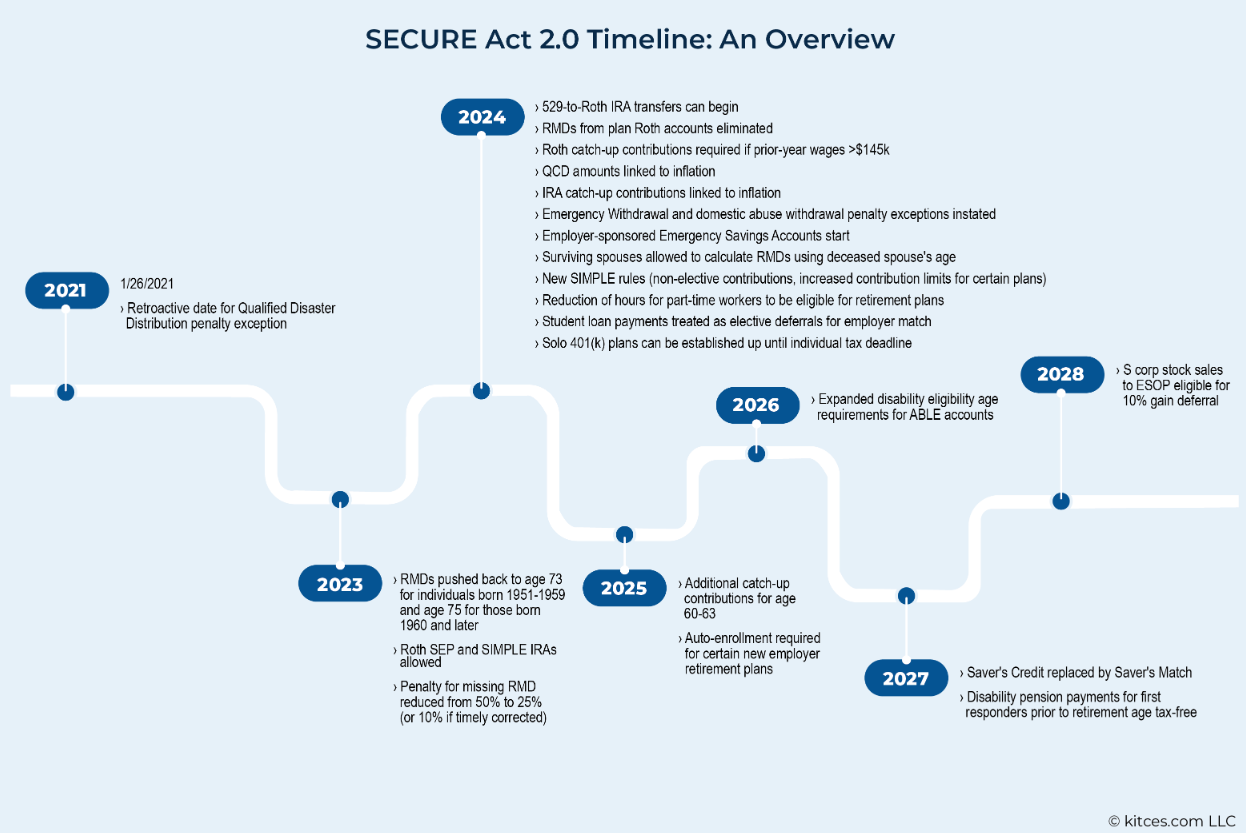
Chart Sourced from: Kitces
** The information provided should not be interpreted as a recommendation, no aspects of your individual financial situation were considered. Always consult a financial professional before implementing any strategies derived from the information above.