




Aligning Your Pocketbook with Your Purpose
Marty Rascon, CFA, Wealth Management Advisor | Aubrey Brown, CFP®, EA, M.S. Wealth Management Advisor | November 19, 2026
When it comes to giving away your assets, you have two main choices: to charity or to individuals. While the decision to gift money generally starts with a desire to support a cause or loved one, it is important for donors to understand the benefits available and recent tax law changes. While our prior charitable blogs WAM’s Guide to Giving and Giving and Gravy outline specific examples, this blog focuses more on the “who” and “when” as it relates to giving and how it aligns with your pocketbook.
TAX LAW CHANGES – OBBBA
Historically, donating to 501c3 charities provided a deduction for those who itemize on Schedule A of their tax return. This essentially reduces taxable income, which is valuable especially for those in high tax brackets. The One Big Beautiful Bill Act (OBBBA) that passed on 7/4/2025 expanded upon the rules surrounding donations, now allowing up to $1K (or $2K for married couples) charitable deduction for even those who don’t itemize, starting in 2026. However, the same bill created a new hurdle for those itemizing because now charitable giving is subject to a 0.5% AGI floor (see table below). Lastly, for those in the highest tax bracket, the new rule caps the tax benefit of their itemized deductions at 35%.
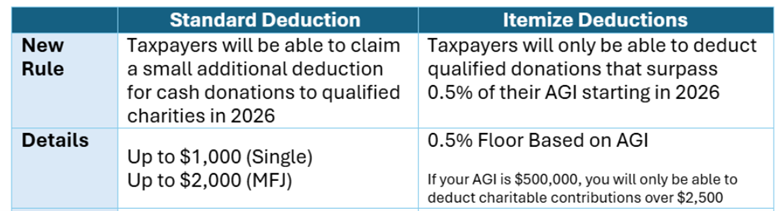
In short, the new bill creates new opportunities for those claiming the standard deduction while presenting new challenges for those who itemize.
WHEN: GIFTING DURING LIFETIME
Gifting should be considered with careful planning. Decisions on how much, to who and how to gift can impact estate planning, taxes due and even help reduce risk within an investment portfolio. However, it’s important to ensure there are enough cash and assets to support the donor over their lifetime. There are multiple ways to gift to either charities or individuals as we explore below.
WHO: CHARITIES
For those over age 70.5, a Qualified Charitable Distribution (QCD) from an IRA is a powerful tool for non-itemizers and under the new rules is an even stronger option for those who itemize. QCDs are considered non-taxable distributions from IRAs and can also count towards required minimum distributions. For those under 70.5 years old, a Donor Advised Fund (DAF) can be a great vehicle to accomplish charitable goals, also allowing donors to “bunch” giving in higher tax years. We created the following flow chart to assist in decision making for gifting to charity during one’s lifetime.
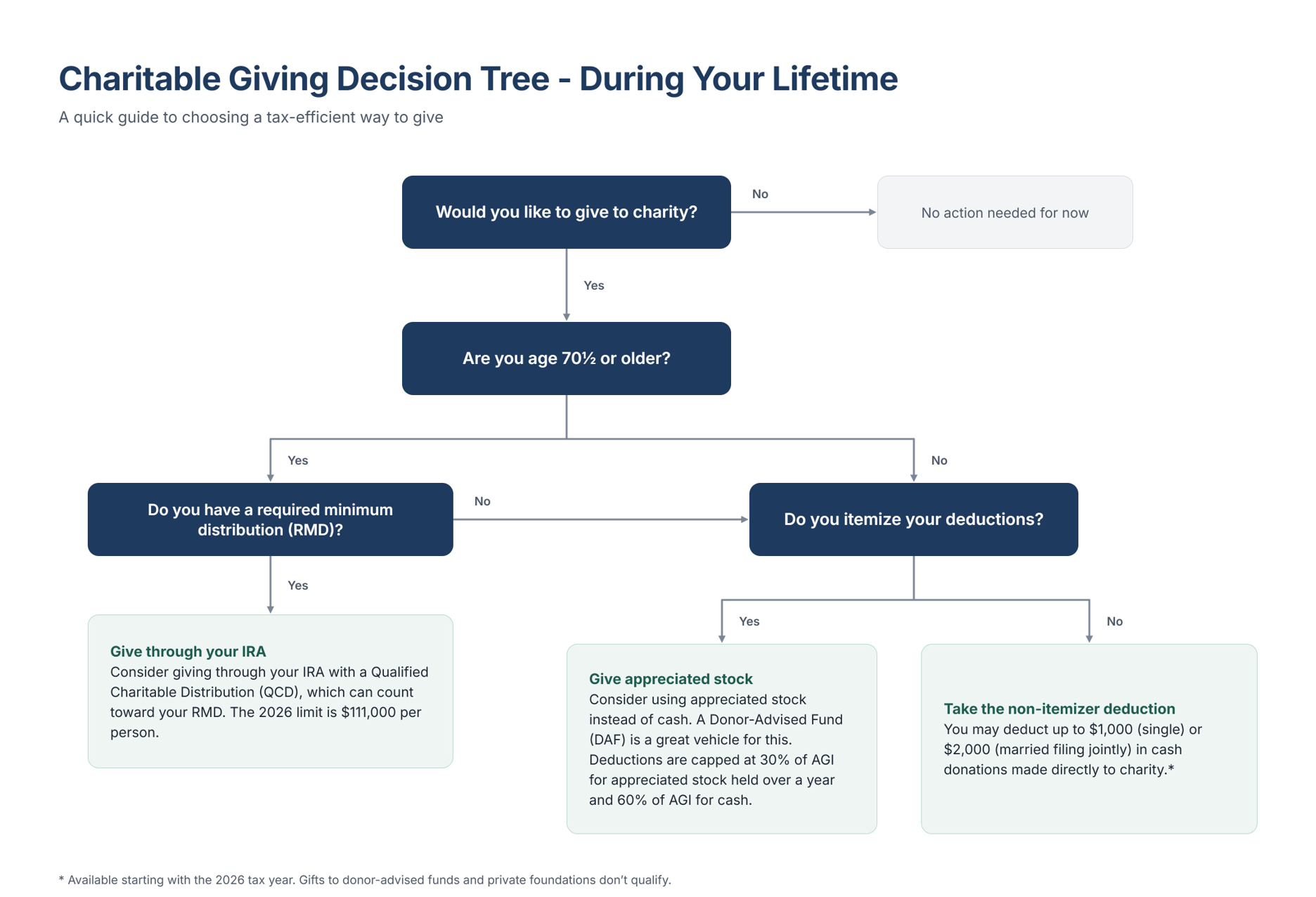
*image is AI Generated
Other considerations –
- The flowchart above is not financial or tax advice. Any actual decisions should be made with your advisor, accountant and/or estate attorney.
- DAF contributions can cause someone to shift from taking the standard deduction to itemizing deductions. A bunching strategy can help identify years that would be beneficial to add to a DAF versus taking the standard deduction.
- Charities in the chart represent 501c3 tax-exempt organizations.
- The 0.5% AGI floor may impact deductible amounts on DAF contributions.
While the chart illustrates the most common ways to give to charity, there is also the option to pursue another strategy in the form of a Charitable Remainder Trust (CRT). By donating assets to a CRT, the donor receives a tax deduction in the year the trust is funded and retains an income stream through the duration of the CRT’s terms. This can be particularly impactful in high tax years and funding with low basis stock or other qualified assets. Once the CRT term expires, the remaining funds in the trust are fully donated to the specified charit(ies).
WHO: INDIVIDUALS
Giving to individuals usually comes in the form of a check/cash and offers no tax deduction. The classic scenario would be parents gifting to their children around the holiday season or to help with a large purchase. The current (2026) annual gift tax exclusion amount is $19K per person ($38K for married couples). Gifts over the annual exclusion amount require a separate tax filing (Form 709) and reduce the grantor’s lifetime gift exclusion. However, when you factor in spouses, kids and grandkids, the annual gifting can really add up without the need for a separate tax filing. To funnel even more money to kids or grandkids, one can consider superfunding a 529 college savings plan. This is specific to 529 plans and allows 5 years of gifts to be combined into one contribution.
Another option to consider would be gifting shares of securities instead of cash. This can help with offloading concentrated securities, especially with low basis. In this instance, the recipient adopts the cost basis and can choose to sell/realize gains based on their tax bracket and timing. This can make even more sense if gifting long term appreciated shares to someone in the 0% capital gains tax bracket.
WHEN: GIVING POST DEATH
The Great Wealth transfer is currently under way as it is anticipated that $124 trillion will change hands in the next two decades. It is very important that clients review their estate plans to structure them in ways that could potentially help maximize post-tax dollars for beneficiaries.
WHO: CHARITIES
If someone wants to give to a 501c3 charity upon their death, it is best to list them as beneficiaries of a pre-tax IRA. Since charities are tax-exempt entities, they are not subject to the IRA taxes and are excluded from estate tax.
WHO: INDIVIDUALS
It may be best for individuals to inherit Roth IRAs and taxable assets that receive a step up in cost basis at death, such as those held in a revocable trust account or individual account.
WHY:
Proper estate planning could potentially help your heirs keep more of your legacy. For IRAs specifically, 2019 tax law changes now force most non-spouse beneficiaries to deplete the IRA assets over a 10-year period rather than over their lifetime. This could potentially cause unnecessary tax complications, especially if the beneficiaries are high income earners. By naming a charity as the beneficiary, the charity can avoid income taxes due and fully utilize the funds to fulfill their mission. Below, we have created a hypothetical example illustrating the power of proper estate planning and the impact of who inherits what type of account.
Case Study: A California resident has $4 million in investment assets. $2 million is held in a pre-tax IRA and $2 million is in a revocable living trust account with a cost basis of $500K. At her passing, she intends for half her money to go to charity and the other half to go to her only niece to use for a home purchase.
Example 1: Client passes away with charity listed in her trust documents and her niece as 100% beneficiary of her IRA. Niece needs money for home purchase.
After considering taxes –
Charity receives $2M. Niece receives $1,075,000*.
*Assuming the Niece has no income, if she took it all out in year one for a home purchase, she would fall in the highest federal (37%) and CA state (13.3%) income tax brackets. Based on the tiered schedule, she would net approximately $1,075,000. The Niece would be better off withdrawing the funds in equal installments over 10 years to spread out the tax burden and keep tax brackets lower.
Example 2: Same example, but the charity is listed as the 100% beneficiary of the IRA, and the Niece is listed in her trust documents.
After considering taxes –
Charity receives $2M. Niece receives $2M**.
**At passing, the trust account received a step up in cost basis. The Niece was able to liquidate the shares with no tax impact to her and use the full $2M for her home purchase.
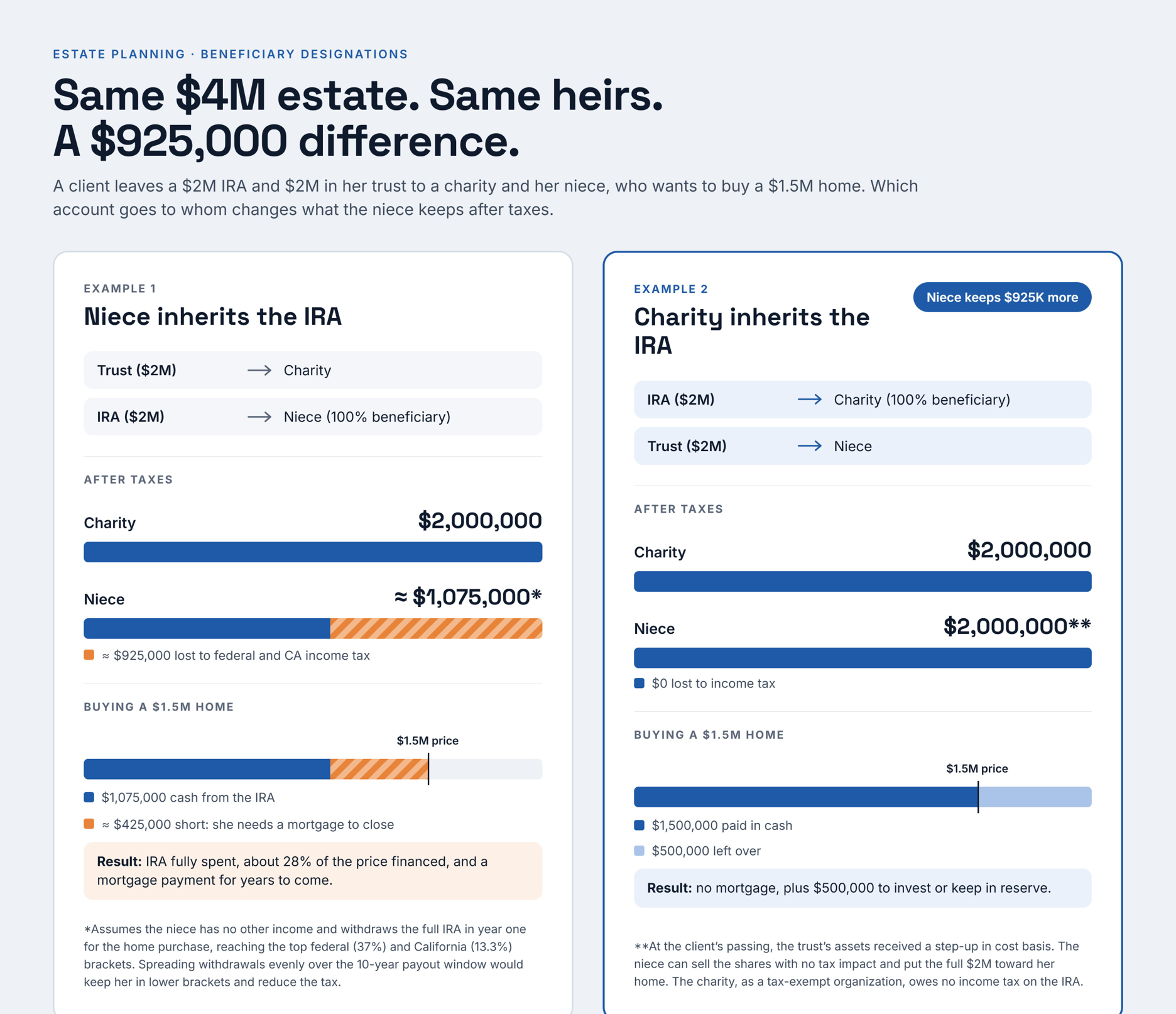
*image is AI Generated
As our two examples illustrate, thoughtful estate planning between charities and individuals can make a meaningful difference. By naming the charity as the IRA beneficiary, your chosen cause receives the full value of its gift, while your heirs inherit assets that receive a step up in cost basis and can avoid a large tax bill, helping to maximize the legacy you leave behind. This really outlines the importance of full asset overviews. Plans can often change in life, so reviewing account allocations, estate plans and beneficiaries should be done in concert with one another to ensure proper set up.
How Weatherly Can Help
Giving to charities and loved ones starts with generosity, but giving efficiently starts with an intentional plan. Understanding your situation, recent changes in tax law, and how your giving fits into your estate plan is essential to making the most of the legacy you leave behind. With charities, the way you give can change your tax bill. Writing a check and making a Qualified Charitable Distribution from your IRA can have very different tax results. With individuals, spreading gifts across family members within the annual exclusion avoids a separate gift tax return. Gifting appreciated stock can also help you trim concentrated positions and shift the gains to recipients in lower tax brackets. Looking ahead, a well-structured estate plan can be the difference between losing part of your legacy to taxes and making sure your favorite causes and heirs receive its full value. At Weatherly Asset Management, we understand that every situation is unique, and our advisors are here to guide you through your giving journey, whether that’s today or in the future.
** The information provided should not be interpreted as a recommendation; no aspects of your individual financial situation were considered. Weatherly is a registered investment advisor and does not provide legal advice. Always consult your trusted financial and legal professionals before implementing any strategies derived from the information above. This blog was developed with the assistance of artificial intelligence (“AI”) tools. These tools were used to help generate initial outlines and graphics, organize ideas, and improve efficiency in communication and grammar.