




When Should I Take Social Security?
Andrea Taylor, CFP®, CPA, MSA Wealth Management Advisor | Chase Hayhurst, CFP®, Senior Wealth Management Advisor | August 13, 2026
In 1940, Ida May Fuller, a 65-year-old retired legal secretary, received the first ever Social Security check. After three years of contributions totaling $24.75, her first monthly check came to $22.54.
She went on to live to 100, collecting nearly $22,888.92 in lifetime benefits, which would be equivalent to over half a million dollars in 2026. She paid into a system built to protect people from outliving their money and happened to live a very long life. Her story captures a universal problem the program aims to solve- longevity insurance.
The questions we hear most often about Social Security surround when to take it, and that’s what we hope to answer today. The mechanics are relatively straightforward. The answer to “when” is less clear since it depends on health, income, marital status, taxes, and other unknown variables.
Back to the Basics: 62 vs 67 vs 70
The mechanics are not complicated. Claim at 62 and lock in a smaller monthly check. Claim at Full Retirement Age (67 for most people) and receive 100% of your calculated benefit, known as your Primary Insurance Amount (PIA). Wait to claim until 70 and receive 124% of that benefit. The range is wide, the difference between the lowest and highest possible benefit ranges by 54%, which gives the decision financial weight.
Although, financial mechanics are only a portion of the greater picture. Life circumstances such as health, household, income, and family situations carry equal weight. It is finding a balance between the mathematical and behavioral side of finance that will help get you to the right answer.
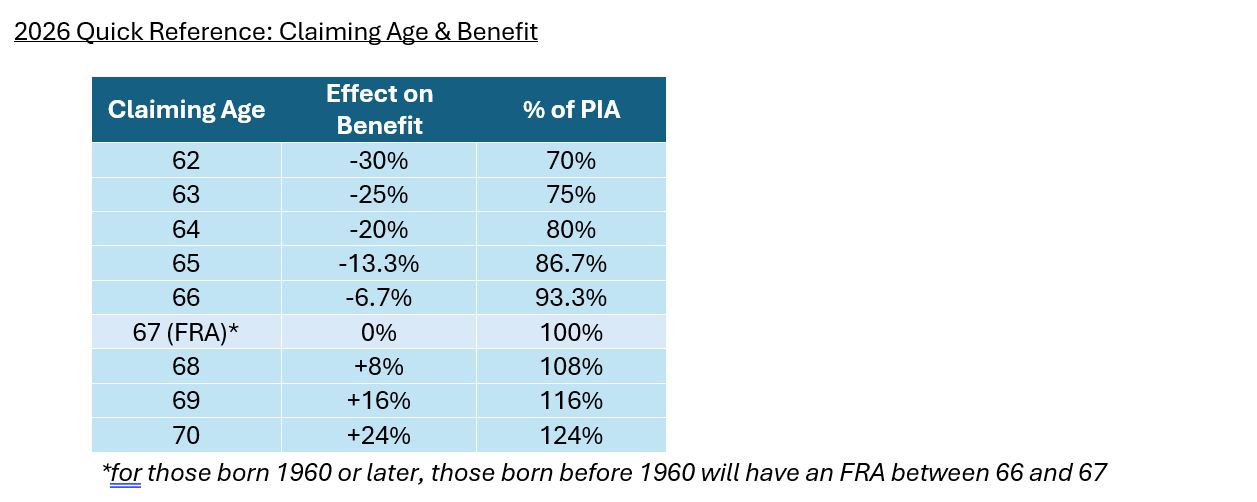
See your Full Retirement Age (FRA)
The Mechanics: Breakeven Analysis
A breakeven analysis compares the cumulative dollars received between two claiming ages and identifies the age at which claiming later in life catches up. The numbers land in a relatively consistent range:
- Claiming at 62 vs 67: breakeven around age 78-79
- Claiming at 62 vs 70: breakeven around age 80-81
- Claiming at 67 vs 70: breakeven around 82-83
If you expect to live past your late 70s or early 80s, delaying produces more total lifetime income. For one reason or another, if you do not anticipate having a long lifespan, claiming earlier may make sense for you. That being said, the breakeven analysis only measures cumulative dollars. It does not account for what an early benefit could have earned if invested, the impact to a surviving spouse or how taxes interact with other income. It’s a useful data point but not the sole answer to your decision.
When Should You Take Social Security?
Consider taking early if:
- You’re managing poor health or a shortened life expectancy
- You have limited liquid assets to cover retirement expenses without the income
- You have little concern over survivor benefits (you’re single or your spouse has their own higher benefit)
- You experienced job loss or a forced retirement with no bridge income in place
- You want to reduce sequence-of-returns risk; claiming earlier can take pressure off a portfolio in the first/most vulnerable retirement years, particularly if markets are volatile
Consider taking later if:
- You’re the higher-earning spouse in a married couple
- Your younger spouse is still working
- You’re in good health with above average family longevity
- You have other income (pension, rental income, etc.) that can bridge the gap without drawing on your portfolio
Important Factors: Social Security and Funding Retirement
When asking “what age should I claim Social Security?” it becomes less of an isolated decision and more of a retirement planning conversation. Weatherly works closely with our clients to gather as much information as possible to optimize your Social Security benefit strategy. Often this involves running a Financial Evaluation to evaluate how income flows and investment asset classes can be leveraged to cover retirement expenses over a client’s lifetime.
Investment Withdrawals
Delaying Social Security may mean funding the gap years from your portfolio. While that means drawing down assets sooner, it can also build toward a larger, inflation-adjusted benefit later in retirement. This tradeoff carries particular weight in the first few years of retirement, when a market decline can have an outsized impact on a portfolio. Sufficient cash reserves or a flexible withdrawal strategy can bridge the gap to a later claiming age without forcing the sale of investments during a downturn.
Claiming earlier works in the opposite direction, reducing how much needs to come out of the portfolio and offering some protection against sequence-of-returns risk. The right approach depends on portfolio size, spending needs, liquidity, investment allocation, and a client’s tolerance for market volatility and capital gains.
Required Minimum Distributions (+QCDs)
For retirees with significant Traditional IRA or 401(k) assets, delaying Social Security should be viewed alongside future Required Minimum Distributions (RMD) obligations. The lower income years between retirement and claiming can be a strategic window to draw down retirement accounts, potentially reducing future RMDs and creating a more balanced tax liability over the course of retirement.
For charitably inclined retirees, Qualified Charitable Distributions (QCD) can become part of this same strategy once eligible at 70½ years old. A QCD can satisfy all or part of an RMD while generally keeping the distributed amount out of adjusted gross income. For 2026, the QCD limit is $111,000 per individual, doubled for married couples filing jointly. Coordinating charitable giving, retirement account withdrawals, and Social Security together can provide opportunities that wouldn’t be apparent when looking at Social Security in isolation.
Tax planning: Roth Conversions, Pension Income, and Capital Gains
Retirement gap years can open the door to several planning opportunities. Most notably, Roth conversions at lower marginal rates could be implemented before Social Security and RMDs begin. Or alternatively, depending on asset mix, it may be a good time to realize capital gains at the preferred federal rates to increase liquidity in taxable accounts.
Other income sources matter too. Once benefits begin, up to 85% of Social Security can become includable in a retiree’s taxable income, depending on provisional income. The income that may be funding your retirement, such as pension income, rental income, interest, dividends, and capital gains, all factor into the tax consequences of claiming.
Most states don’t tax Social Security benefits, but it’s worth understanding the treatment at the state level as part of the plan. Link to states that don’t tax retirement income.
Health, longevity, and survivor/spousal benefits
For someone in good health with a family history of longevity, delaying benefits can provide a larger stream of inflation-adjusted income later in life, when other assets may have declined and healthcare or long-term-care expenses may be higher. Conversely, someone facing significant health challenges or with a materially shorter life expectancy may place greater value on receiving benefits earlier.
For married couples, Social Security should be viewed as a household decision rather than two separate claiming decisions. The higher-earning spouse may benefit from delaying their own benefit, particularly because doing so can increase the survivor benefit available to the lower-earning spouse if they pass first. By contrast, delaying the higher earner’s benefit beyond Full Retirement Age does not increase the spousal benefit. A spouse with a lower benefit may generally receive up to 50% of the higher earner’s Full Retirement Age benefit, but that amount can be reduced if the higher earner claims earlier. Ultimately, the timing of each spouse’s benefits should be evaluated together, with particular attention to the potential impact on survivor income.
Social Security Funding and Considerations
No conversation about Social Security today is complete without addressing the funding question directly. The Social Security Trust Fund is projected to face depletion within the next decade. If lawmakers fail to act, benefits could be reduced across the board. Likely paths to shoring up the program include some combination of delayed FRA, lower benefits, or increased taxes to help fund. Benefit cuts remain politically unpopular and Congress has intervened similar junctures before but the possibility alone is enough to factor into some retirees claiming earlier.
We expect Social Security will remain in some form well into the future. For most people, regardless of what happens in Congress or the economy at any given time, Social Security won’t be enough to fund retirement on its own. It has always been designed to be the foundation, working in concert with other assets to get the full retirement picture.
The Bottom Line
There is no single age that is right for everyone. The “better” decision depends on how Social Security fits with your other income and assets. For many retirees, Social Security is more than just another source of income, it is the foundation of their retirement income. Roughly 14% of retirees rely on Social Security for at least 90% of their income, highlighting how important the timing and sustainability of this benefit can be. For most households, the key is how Social Security coordinates with a comprehensive retirement income plan.
Weatherly can help bring clarity to that decision by weighing the full picture together: cash flow planning, investment portfolios, tax planning, and longevity, all working in concert to help maximize each individual or family’s benefit. Please reach out to your trusted advisor if you have questions or would like to schedule a meeting.
** The information provided should not be interpreted as a recommendation; no aspects of your individual financial situation were considered. Weatherly is a registered investment advisor and does not provide legal advice. Always consult your trusted financial and legal professionals before implementing any strategies derived from the information above. This blog was developed with the assistance of artificial intelligence (“AI”) tools. These tools were used to help generate initial outlines, organize ideas, and improve efficiency in communication and grammar.