




Flight to Safety: How Gold, the Dollar, and New-Age Assets Are Redefining Stability
Chase Hayhurst, CFP®, Senior Wealth Management Advisor | Ryan Richardson, CFP®, ChFC®, Senior Wealth Management Advisor | November 13, 2025
A Flight to Safety Returns
Shifting geopolitical alliances, richly valued markets, rising U.S. debt, and persistent inflation have investors rebalancing portfolios and seeking safe havens. While the U.S. dollar remains the world’s dominant reserve currency, its status is being tested by growing challenges – from fiscal imbalances, geopolitical shifts, and a global move to diversify reserves.
Today’s “flight to safety” is broader and more complex than in past cycles. Investors are no longer limiting their search to gold or Treasuries alone. Instead, the safety trade now spans digital assets and select high quality dividend-paying equities and consumer staples, as investors seek a blend of protection, liquidity, and real returns amid fiscal and market uncertainty.
The Flight to Safety – and the Dollar’s Waning Grip
The U.S. now faces record debt exceeding $35 trillion, rising interest costs, and persistent inflation, all against a backdrop of multiple geopolitical conflicts. These pressures have eroded confidence in fiat currencies and the stability of U.S. fiscal policy.
For the first time in decades, central banks are actively diversifying away from the dollar, reducing reserve exposure and favoring assets like gold, the yen, and the franc. According to the International Monetary Fund, “the dollar share of global foreign exchange reserves has declined from 65 percent a decade ago to less than 58 percent today,” while central bank gold buying has surged to its highest pace in half a century.
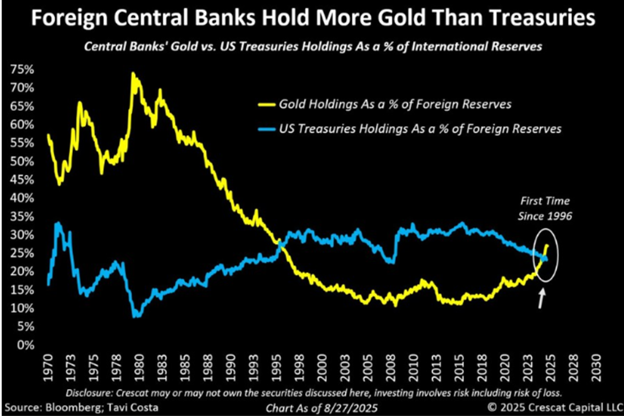
Chart Source: Reuters.com
Countries such as China, Russia, and Turkey have been steadily reducing U.S. Treasury holdings, while simultaneously increasing gold reserves and completing trade settlements in local currencies.
At the same time, the BRICS bloc (a group of major emerging economies including Brazil, Russian, India, China, and South Africa) and other emerging economies are accelerating efforts to settle trades in non-dollar currencies, which is part of a broader movement toward financial independence from U.S. policy influence and sanctions risk.
Still, the dollar’s dominance remains intact for now. U.S. Treasuries continue to represent the world’s most liquid and trusted safe asset, and America’s deep capital markets are unmatched. Yet the trend is clear: the world is quietly hedging against U.S. policy uncertainty and currency concentration risk. For both central banks and individual investors, this shift highlights a growing preference for assets that preserve value rather than chase growth, reshaping what safety means in a changing global order.
The U.S. debt-to-GDP ratio, now above 120%, underscores why confidence in fiscal responsibility is waning. With interest costs projected to surpass defense spending by 2026, investors are beginning to question whether the “risk-free” rate remains truly risk-free.
Gold’s Renewed Role as the Ultimate Store of Value
Gold’s recent resurgence reflects the changing monetary environment reflecting the idea that, when confidence in fiat currency wanes, investors return to tangible stores of value. In 2024, central banks purchased 1,044.6 metric tons of gold – the third year in a row that gold purchases surpassed the 1,000 metric ton mark, echoing the behavior seen during the 1970s inflation spike and the 2008 financial crisis.
This renewed accumulation is not just about diversification; it’s about independence. For emerging-market central banks, holding gold reduces the risk of sanctions, while providing a universally recognized store of wealth that can’t be frozen or devalued by policy.
Gold’s appeal lies in its timeless qualities: it is scarce, unobstructed by credit risk and less influenced by political factors than fiat currencies. Alongside gold, U.S. Treasuries, the Swiss franc, and the Japanese yen remain trusted hedges, each benefiting from deep liquidity, credibility, and perceived neutrality in turbulent times.
While gold offers no yield, it has historically helped diversify portfolios and preserve purchasing power during inflationary or geopolitical shocks. Silver and platinum have also benefited from this flight to tangible value, blending precious metal scarcity with industrial demand themes in clean energy and technology sectors.
The Digital Dimension: Bitcoin and New-Age Havens
Some investors now view Bitcoin as a complementary store of value as it is decentralized, limited in supply, and increasingly accepted by institutions. While it doesn’t replace traditional havens, it has emerged as a new accessible alternative available to investors of all types. Over the past few years, we’ve seen Bitcoin move from a speculative asset to institutional adoptions from major asset managers such as BlackRock and Fidelity. This legitimization has also been reflected within government policy from emerging markets to advanced economies like the U.S. and the E.U. with the acceptance of spot Bitcoin ETFs and experimenting with central bank digital currencies. However, Bitcoin remains volatile due to its perceived value, limited history, government regulation, in addition to supply and demand dynamics. Multiple avenues to gain access to virtual currencies, global liquidity and accessibility have helped increase retail and institutional investors’ adoption as a potential hedge.
More traditional defensive equity sectors such as consumer staples, healthcare, and reliable dividend-paying stocks continue to offer income, stability and modest growth, appealing to investors seeking consistent returns amid volatility. While there is no universal approach to determining the right level of exposure to new-age havens, the key is to maintain thoughtful diversification while ensuring each allocation aligns with the portfolio’s long-term objectives, time horizon, and risk tolerance.
Implications for Investors
A weaker dollar has historically provided a strong tailwind for real/alternative assets, commodities, and foreign holdings, which are typically priced in dollars. When the dollar declines, international buyers can purchase these assets more cheaply, boosting demand and pushing prices higher. Combined with economic and fiscal uncertainties domestically, we’ve seen investors flock to these assets throughout 2025.
Recent Historical examples illustrate this pattern:
Early 2000s (2002–2008): Following the dot-com bust and a series of rate cuts, the dollar weakened sharply. During this period, gold tripled in value, oil surged from around $20 to over $100 per barrel, as broad commodity indices such as the CRB Index also rallied, driven by global demand and a favorable currency backdrop.
Post-2020: Bitcoin soared over 300% in 2020 and U.S. equities rallied from a reopening of the global economy as fiscal stimulus was pumped into financial systems. As a result, inflation ran away, hitting 9.1% in June of 2022. The dollar retreated from its pandemic-era highs, while gold, silver, and energy commodities rallied once again—reflecting both inflation concerns and a global move to diversify away from fiat currencies.
Beyond real assets, a weaker dollar also amplifies foreign corporate earnings when translated back into U.S. dollars. For multinational firms based outside the U.S., overseas revenues become more valuable in dollar terms, improving profitability and often lifting share prices of international equity funds and ADRs (American Depositary Receipts).
For investors, this reinforces the value of diversifying beyond U.S.-only exposure, as a weakening dollar can serve as a tailwind for non-U.S. assets. Historically, periods of dollar decline have coincided with outperformance in international and emerging-market equities, as well as commodities and real assets that benefit from stronger global demand.
At the same time, traditional safe havens such as gold, foreign currencies and high-quality sovereign bonds continue to play an essential stabilizing role, while select digital assets—most notably Bitcoin—are emerging as complementary stores of value in an increasingly decentralized financial system. Defensive equity sectors like consumer staples, healthcare, and utilities remain reliable anchors for income and capital preservation both domestic and international.
Adapting to a Multipolar Monetary Future
With volatility stemming from fiscal uncertainties, geo-political pressures, inflation and stretched equity valuations, it’s imperative that investors take an honest look at their portfolios and ensure they are properly diversified to hedge against potential market disruptions. This modern flight to safety looks both familiar and new – spanning gold, foreign currencies, U.S. Treasuries, non-US securities, dividend paying equities, and a growing class of digital and alternative assets that reflect the evolving nature of global finance.
While no asset is completely free of risk, Weatherly helps clients find the right balance between opportunity and protection. Because each client’s goals and circumstances are unique, we take a personalized, planning-driven approach—ensuring portfolios are thoughtfully positioned to weather any market environment. At Weatherly, we’ve been working with our clients to ensure portfolios remain balanced and diversified across their equity and fixed income sleeves while targeting a neutral asset allocation. With strong domestic equity returns over the past years, we are taking this opportunity to work with clients on shaving equity positions, charitable gifting and tax-conscious risk reduction strategies. Our team is here to talk through your portfolio to ensure your financial plans remain on track for whatever tomorrow brings.
Sources:
https://www.visualcapitalist.com/sp/charted-a-decade-of-central-bank-gold-purchases/
*Disclosures:* The information provided should not be interpreted as a recommendation, no aspects of your individual financial situation were considered. Always consult a financial professional before implementing any strategies derived from the information above.
Blog content is human-generated by the Weatherly team members. AI was used to assist with generating titles and subtitles.